
Exhibition Essays
Adorn yourself accordingly
September 2026
Adorn yourself accordingly
Brooke Pou
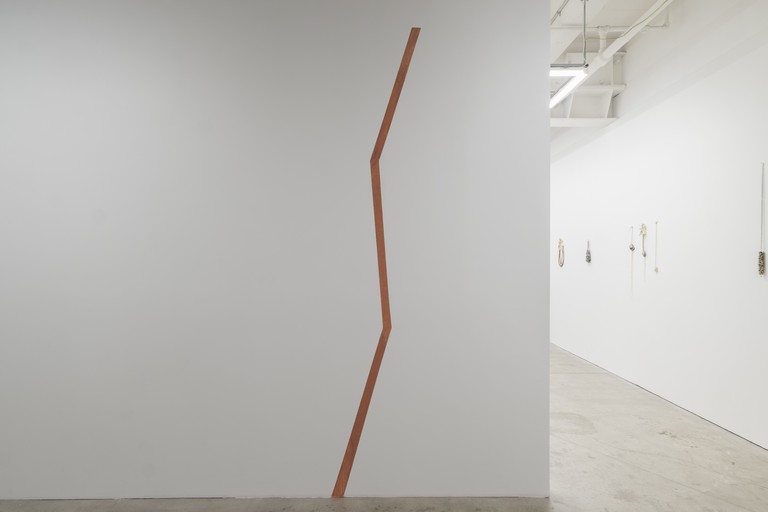
Arawhetu Berdinner, Kōkōwai painting, 2026. Photo by Samson Dell.
Adorn yourself accordingly brings together the work of three emerging artists living in Te Upoko o te Ika a Māui, under the broad theme of Māori and Moana adornment. Arawhetu Berdinner, Bailey Gardner, and Te Māreikura Whakataka-Brightwell each look inward before beginning to create. The adornments within this exhibition are grounded in their makers’ sense of self—their whakapapa, their connection to Tangaroa (among other atua), and their interests.
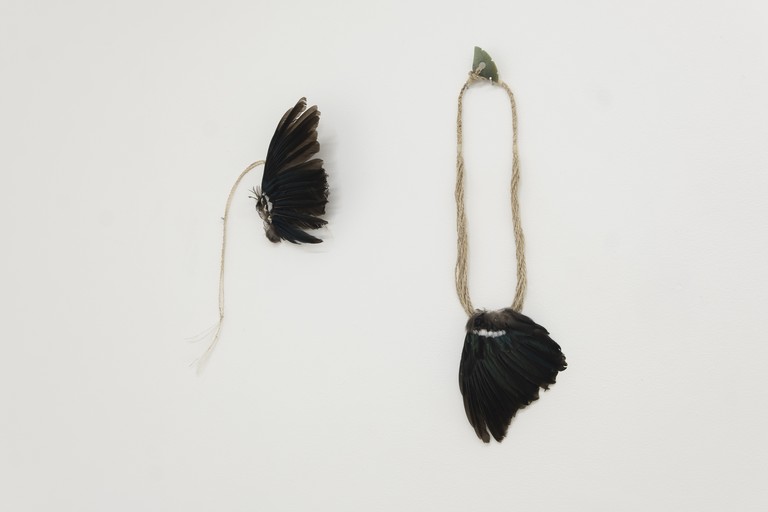
Arawhetu Berdinner, Tāraro tūī - hair adornment, parirau tūī, muka, aute/tapa kōkōwai/preserved tūī wing, flax fibre cordage, barkcloth, earth pigment, 2026 & Tuia, parirau tūī, kōkōwai, muka, inanga pounamu/preserved tūī wing, earth pigment, flax fibre cordage, nephrite jade, 2025. Photo by Samson Dell.
Arawhetu Berdinner’s practice is deeply rooted in mātauranga Māori methodologies, ancestral pathways, and engaging with ngā atua Māori. Through the works presented in this exhibition, Berdinner seamlessly slips from working within the realm of Hine-tua-hōanga, the personification of grindstone and an atua of carving, to engaging with Hine-te-iwa-iwa, atua of weaving in te whare pora. Tāraro tūī - hair adornment (2026) and Tuia (2025) are made from the wings of the same tūī, skinned in a manu skinning workshop led by Aroha Matchitt-Millar at Enjoy last year. Tuia was made at the beginning of the artist’s Masters journey as a necklace with an inanga pounamu toggle, while Tāraro tūī is a newly created hair adornment with fine white muka marking the end of her studies.
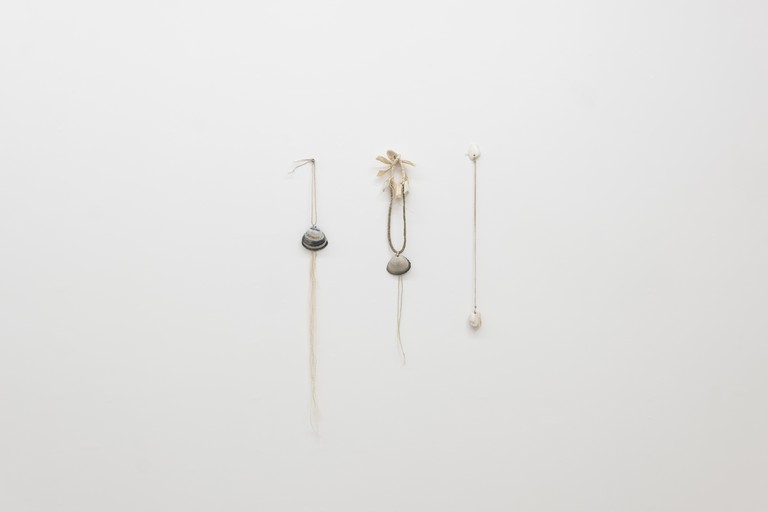
Arawhetu Berdinner, Hei toheroa (toro, toro), muka, toheroa/flax fiber cordage (waxed), flax fibre unwaxed, worked toheroa clam shells, Toro, piko, harakeke, aute/tapa, muka, pipi, toheroa/processed flax, barkcloth, flax fibre cordage, partially mineralised pipi shells, worked toheroa clam shell, Hei pipi (piko, piko), muka, pipi/flax fibre cordage (waxed), partially mineralised pipi shells, all 2026. Photo by Samson Dell.
Tāhei harakeke (2026) and Tēina, tuakana (2026) are thick, plaited harakeke adornments. They feature aute where the necklace would touch the back of the wearer's neck to soften the rough texture where we are sensitive, exemplifying the ways in which Berdinner cares for those who wear her adornments. In Hei toheroa (toro, toro) (2026), the artist uses both waxed and unwaxed muka—the waxed fibres holding the necklace strong around the neck, while the unwaxed fibres flow long beneath the two toheroa shells held in between. These shells, as with that of Toro, piko (2026) once housed the clam that was abundant in the 1950s. My own father fondly reminisces about the excitement of visiting the beach and digging for toheroa as a child in Te Tai Tokerau, where they grow as large as a hand. Those used by Berdinner are much smaller, gathered along the Kapiti coastline. She has been taught by her father, Dennis Berdinner, to carve using both electric tools and hand-carving techniques similar to those used by tūpuna Māori. Berdinner’s research into early Māori and Moana adornments informs her working with water and hōanga to create the notches of the ngau pae pattern that references whakapapa, seen along the edges of the toheroa. The inclusion of partially mineralised pipi shells act as both decoration and as functional toggles. Other gifts from te taiao include the kuku, or green-lip mussel shells found in Motukairangi that are seen in Kōuma Mahara (2026). These massive mussel shells with kōkōwai applied to their surfaces have been carefully arranged around a mother-of-pearl shell to form a contemporary take on a kōuma, or breastplate. Commonly found amongst cultures of the Moana for both ceremonial and practical use, the making of kōuma largely fell out of practice after early Māori settled here. Kōuma Mahara is a nod to our Pacific cousins bound with metres of muka harvested by the artist with friends.
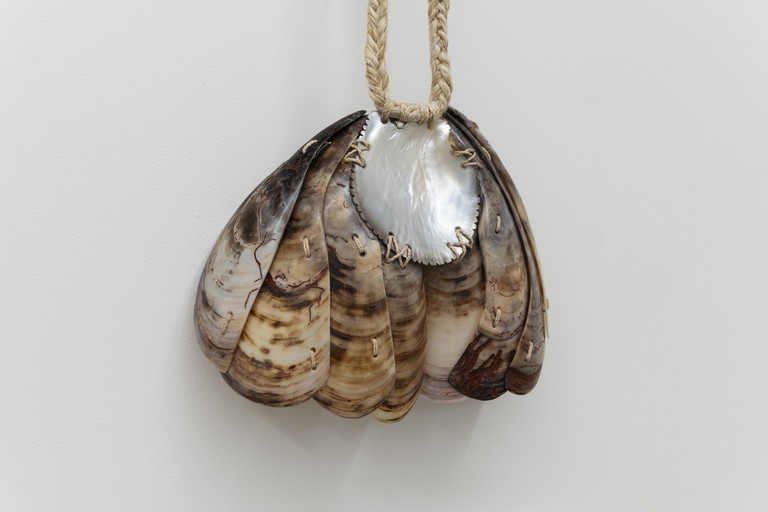
Arawhetu Berdinner, Kōuma Mahara, kuku, te ufi, muka, kōkōwai/green-lip mussel shell, mother-of-pearl, flax fibre cordage, earth pigment, 2026 (detail). Photo by Samson Dell.
Bailey Gardner’s artwork explores the line between respect, love, and fear of Tangaroa. Gardner is hyper aware that climate projections for Aotearoa predict an increase in heavy rainfall that, “alongside our rising sea-level, means both our individual and collective relationship with water is about to get much closer.”1 After a family member's death in 2024, she began experimenting with making jewellery with her collection of found shells as a way of connecting with death and processing grief. As interest in her work grew, the artist began selling pieces at the Newtown market and under the username seapunks.xx on Instagram. The brand's kaupapa has been clear from its outset: work with te taiao using offerings from Tangaroa to create adornments predominantly in the form of necklaces and earrings. Each work is one-of-a-kind and, out of respect to Tangaroa, the works are limited. Conscious of her impact, Gardner uses common shells accumulated from beaches across the country in places she considers home, collected together with family and friends, to produce works on a small scale, valuing quality over quantity. As a self-taught jeweller, Gardner embraces experimental responses to each shell. The natural form of the shell elicits an instinctive reaction from the artist, who looks to the shape and colour before digging into her reserves and piercing them with stainless steel hoops, barbells, and eyelets. These piercings are distinctive. Kinky and punk, they add a sense of danger to the shells that one might assume are delicate in nature. In reality, Gardner has broken a few drill bits on the shells that are tougher than they look.
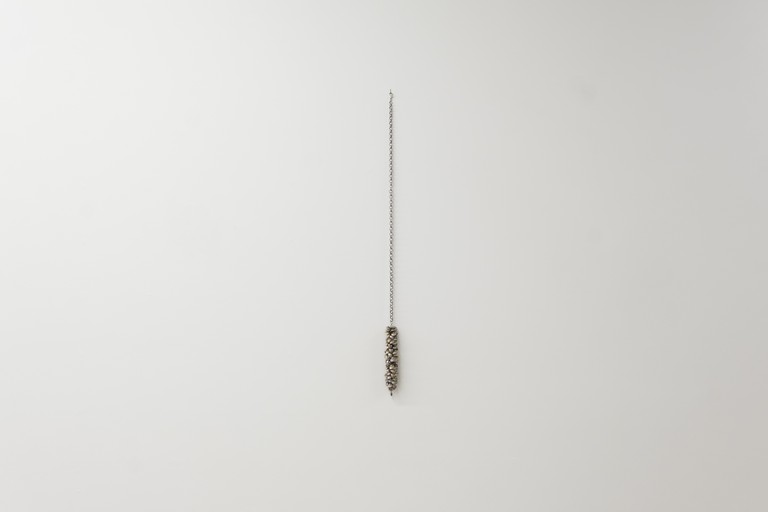
Bailey Gardner, Untitled #2, Pūpū shells, nylon, recycled chain, steel, freshwater pearl, 2026. Photo by Samson Dell.
Untitled #1 (2026) is a dense configuration of pūpū shells. The artist had worked away the black buildup in certain areas, revealing gleaming green and white hues while keeping a tinge of darkness. Pūpū shells originally belong to the snails who live in them, though after dying they will wash up ashore where Gardner combs the beach to find pieces to pierce. A short, handmade box weave adds an anachronistic element to the work. Untitled #2 (2026), featuring a similar pūpū shell, is suspended on a long recycled chain. Described by Gardner as an “unexpected” piece reminiscent of an incense burner, semi-religious object, or weapon, the work balances fear of the future with courage to face it—its single freshwater pearl hanging in freefall.2 Untitled #3 (2026) is made from dozens of pōrohe shells. The small, dark blue mussels attach themselves to rocks in intertidal areas and are abundant as, unlike the kuku (or green-lip mussel), they are not usually commercially farmed in Aotearoa. Studs and curved barbells cover many of the pōrohe here, angled by the artist toward the atāta shell in the centre of the work. Ataata is a te reo Māori word for shadow or reflection, though the atāta shell is known in English as the cat’s eye from the common sea snail. After this snail died and evacuated its shell, it was brought forth by Tangaroa for Gardner to gather and give it another life as an adornment. It is now a shadow representing the life once held within.
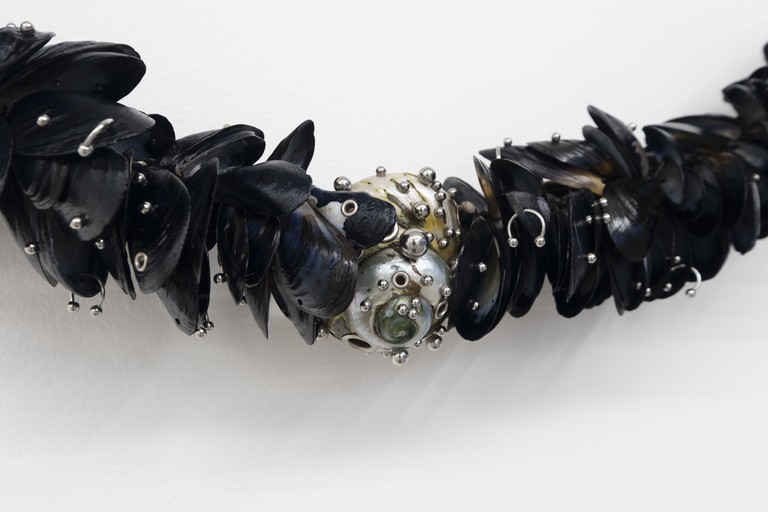
Bailey Gardner, Untitled #3, Pōrohe shells, atāta shell, nylon, steel, iron, 2026 (detail). Photo by Samson Dell.
Describing the need to be “like water”, Gardner’s practice moves, adapts, and flows with our “water logged future”, embracing the tension between feelings of fear regarding our uncertain future with the love and connection to Tangaroa that many tangata moana feel.3 These works are made to feel like armour or a form of protection for the wearer who has little choice but to adapt.
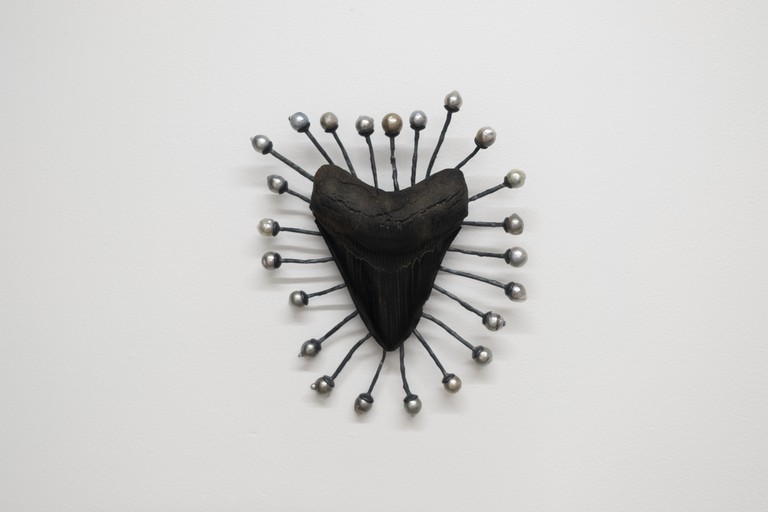
Te Māreikura Whakataka-Brightwell, Sacrum Maris/The Sacred of the Sea, Tahitian baroque pearls, silver, megalodon shark tooth (found in the dark watered Georgia rivers, USA), 2026. Fabrication by Dorthe Kristensen. Photo by Samson Dell.
Te Māreikura Whakataka-Brightwell’s installation, Tipua o te Pō, speaks to the realm of night and the unseen—a place where things are “formed, transformed, and brought into being.”4 Here, Te Pō is not just the night, it is a cavernous space where the artist pays homage to Tahitian tangi rituals. Before entering, viewers look up to Sacrum Maris/The Sacred of the Sea (2026), a reimagined Sacred Heart with a megalodon tooth at its centre, deliberately flipping the focus from divine love revolving around humanity to reverence for te taiao. The Tahitian pearls surrounding the tooth in a halo are imperfect—exactly the kind that the French Polynesian Government has banned and which the artist embraces.
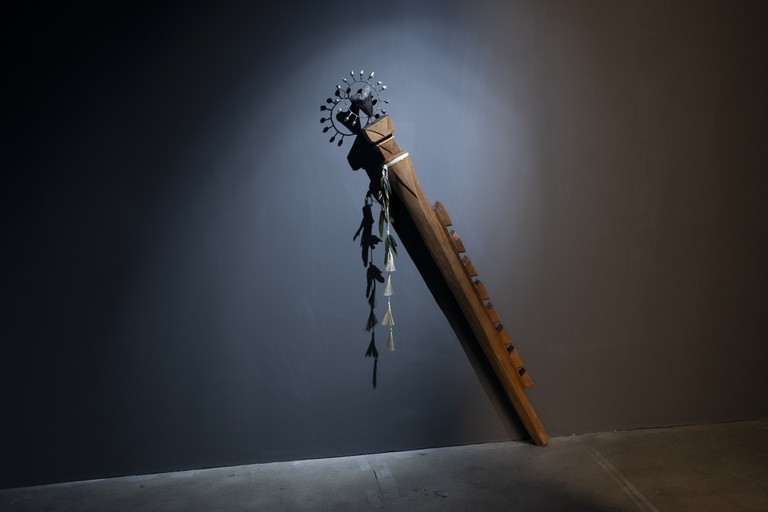
Te Māreikura Whakataka-Brightwell, Vestigium Maris/The Trace of the Sea, Tahitian baroque pearls, copper, megalodon shark teeth, tōtara, muka, tūī feathers, 2026. Fabrication by Dorthe Kristensen, carved by Matahi Whakataka-Brightwell, feathers by Kathy McVey, muka and feather binding by Frank Topia. Photo by Samson Dell.
Whakataka-Brightwell’s soundscape sets the tone for his installation and draws inspiration from Tahitian tarava polyphonic singing and karakia. Layered voices repeating the words "tuituia" and “kawekawea” function as ceremonial commands to bind, to carry. Inside the darkened gallery are contemporary iterations of ceremonial objects with Tahitian, Māori, and European influences. Vestigium Maris/The Trace of the Sea (2026) is a tōtara rākau whakapapa carved by Whakataka-Brightwell’s father and adorned with muka, tūī feathers, a megalodon shark tooth and Tahitian pearls. Customarily used by tohunga while reciting whakapapa, Vestigium Maris is a functional object as well as an artwork. Suspended from steel wiring in this installation are Luctus Maris/The Mourning of the Sea (2026), Favilla Maris/The Embers of the Sea (2026) and Vinculum Maris/The Bond of the Sea (2026). Luctus Maris draws from the Tahitian parae, a headdress worn by the chief mourner in the Tahitian Heva Tūpāpau funerary ceremony. Many cultures of the Moana regard the head as the most tapu part of the body, therefore the materials used to adorn it are significant. Forming this headdress are silver chains, a copper mount with a halo made from Tahitian baroque white pearls and, most importantly, a vintage wild Tahitian mother-of-pearl heirloom that belonged to the artist’s grandmother. Keeping fragments of the Moana so close to one's face during a ritual at the end of a life reminds us that all life originates from the sea.
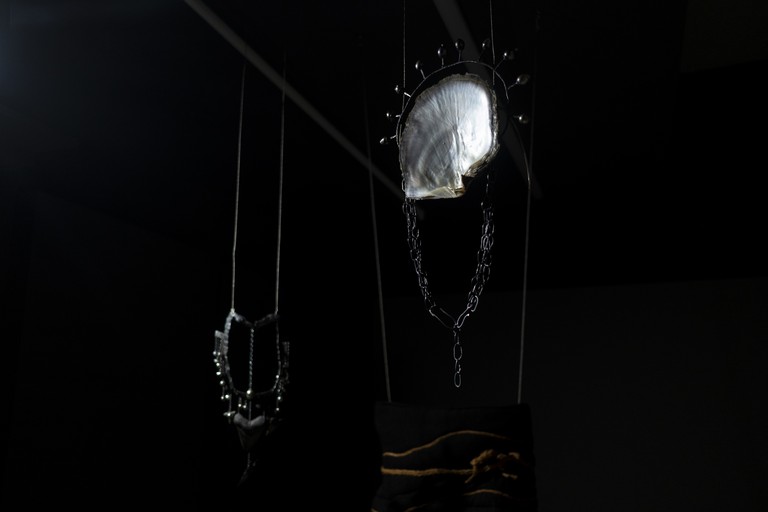
Te Māreikura Whakataka-Brightwell, Te Tipua o te Pō, 2026 (installation view). Photo by Samson Dell.
Favilla Maris takes inspiration from the Tahitian taumi, an adornment worn by high-ranking chiefs during warfare. Customary taumi were made from an array of materials including shark teeth, mother-of-pearl, coconut fibres, dog fur, and feathers. It is estimated that seven to fifteen sharks are required to produce the number of teeth required to create a customary taumi, though Whakataka-Brightwell has used three megalodon teeth and one hemipristis shark tooth, with thirty-two baroque pearls surrounding them.5 Bound by thick tarnished silver reminiscent of Mediaeval European armour, the work bridges cultures and time, much like Vinculum Maris. Featuring Tahitian coconut fibre and Japanese fabric, Vinculum Maris draws on the Tahitian Heva Tūpāpau mourner’s belt. Two strands of Tahitian pearls across the belt binds the wearer physically and symbolically back into relationship with the sea. The artworks in Tipua o te Pō speak to states of transmutation, with each work representing a different state through which Whakataka-Brightwell takes us on a haerenga of grief and growth.
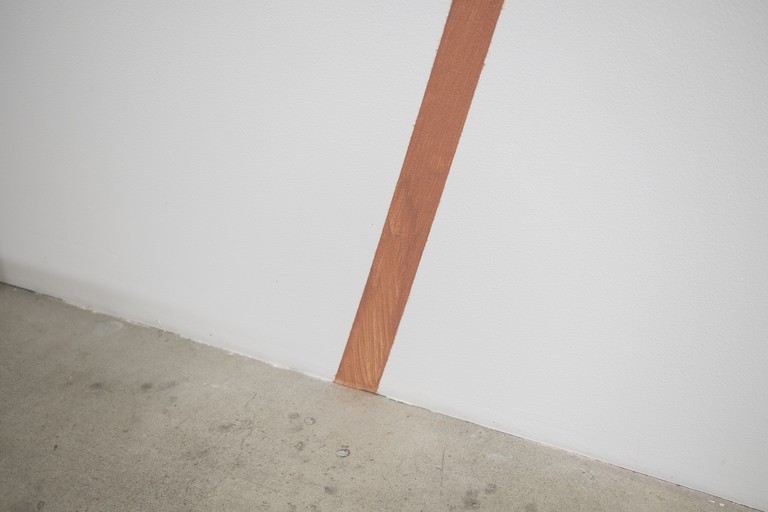
Arawhetu Berdinner, Kōkōwai painting, 2026 (detail). Photo by Samson Dell.
In a final form of adornment—this time for the gallery itself—Arawhetu Berdinner has painted an elongated aramoana design with whenua on our back wall. As Berdinner states,
Kōkōwai, with its association by colour to blood, is present in stories connected to creation, birth, fertility, death, rebirth, bloodshed and to spiritual protection. Kōkōwai thus acts as a lubricant to transition between the physical and spiritual worlds.6
This painting is a temporary adornment acknowledging tūpuna Māori who used kōkōwai to adorn themselves.
-
1.
Communication with the artist, 2 September 2026.
-
2.
Ibid, 11 September 2026.
-
3.
Ibid.
-
4.
Communication with the artist, 8 September 2026.
-
5.
Ruth Jaffit, “Tahitian Taumi - Warrior’s Breastplates,” Australian Museum, 1 December 2017. https://australian.museum/blog/science/tahitian-taumi-warriors-breastplates/.
-
6.
Arawhetu Berdinner, “Karanga Atu” (Master of Fine Arts, Massey University of New Zealand - Te Kunenga ki Pūrehuroa, 2026), 46.