
Exhibition Essays
I ask myself what is healing to me?
December 2025
I ask myself what is healing to me?
Israel Randell
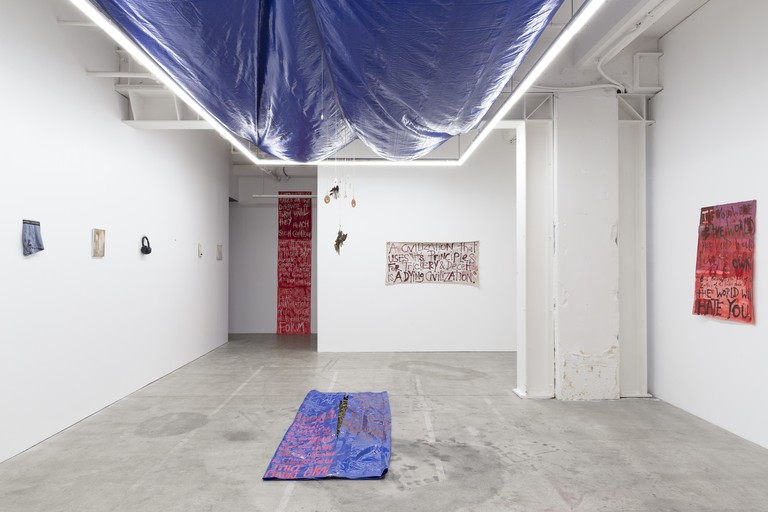
Installation view, An Ethics of Witnessing, Enjoy Contemporary Art Space, Te Whanganui-a-Tara, 2025. Photo by Cheska Brown.
I ask myself what is healing to me?
Am I healing right now? What is holding me
back? What more can I do?
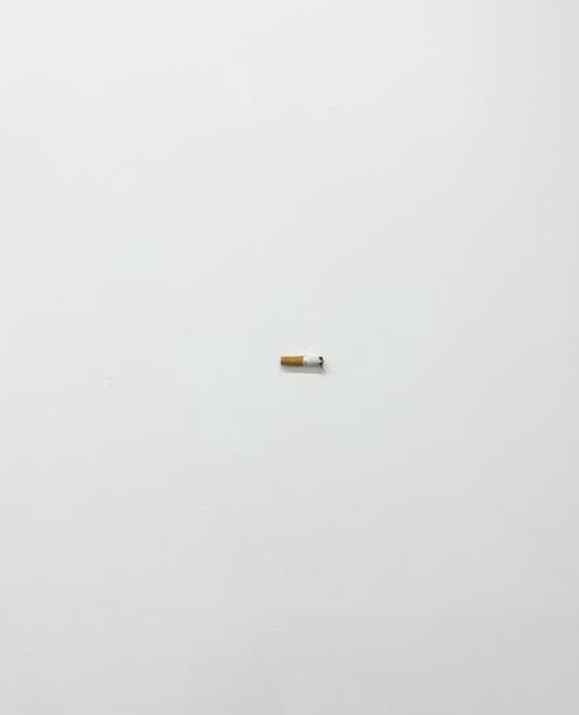
Frankie Matchitt-Millar, Cigarette shared with Carmen Rupe, 2025. Marlboro red and mint gum. Photo by DJCS.
A cigarette butt is pinned to the wall; it is the residue of time spent on (the infamous) Carmen’s bench. Before visitng this exhibition, I didn’t know who Carmen was, or how her whakapapa lingers in these sites that I walk past most days. But I guess that's what this exhibition does: it demands our presence, calling us to witness these histories. The ciggy butt and the benches are touchstones for artist Frankie Mattchit-Millar to trace a whakapapa of takatāpuitanga, here in Te Whanganui-a-Tara. These remnants hang on the wall at the exact height of the artist. A map of the body—of the embodied—these taonga gather mauri here in the gallery. I sit with these works and think:
Am I healing right now? What is holding me
back? What more can I do?
These words, written in Michael Steven’s diary in November 1988, come to mind as I reflect on An Ethics of Witnessing. These words document the questions Stevens asked himself, wondering if his life too will be taken by AIDS, like all of his friends. In some ways, these questions still ring true for the artists in this show. Collectively, they start to map out these words—what is healing to me? What is holding me back and what more can I do?
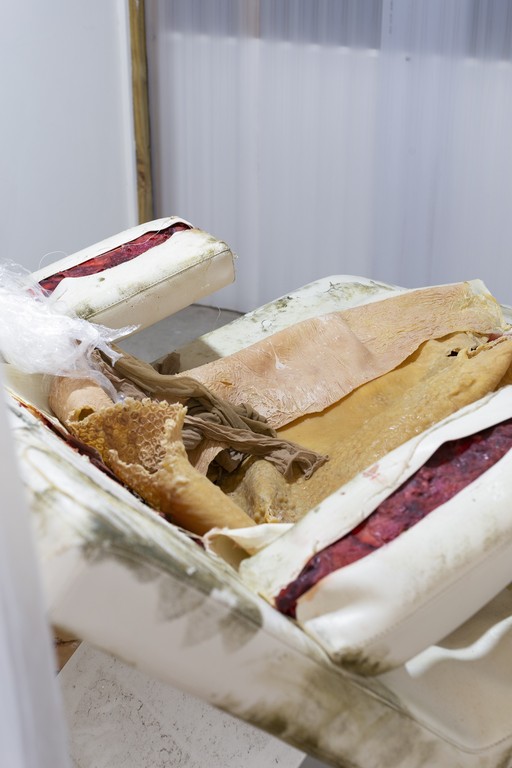
Fetishini, Skin, 2024-25. Liquid latex, foundation, salon chair, food dye, PVA glue, needle and thread. Photo by Cheska Brown.
In the corner of the gallery, through the mystique of plastic material, sits an old salon chair. In it lies a silicon skin—its surface is rough, bodily, and gooey. I know that this is the installation of a performance that I myself was too shy to see. Even the remnants of it are almost too hard for me to stomach. Fetishini’s practice is one that I’m still getting to know. It shapeshifts between slippery materials, evocative of the body morphing. Is this drag though? Or, is it the realness that is left once it’s all taken off—ourselves laid bare. Agency over one's body isn’t always a given; sometimes you have to claw it back from the gloved hands of so-called medical professionals, who we (unwillingly) put our trust in. True Tino Rangatiratanga looks like this sometimes. It looks like recalling your power, moving through physical and mental trauma to find a new sense of power. I see An Ethics of Witnessing as an intentional shift, where the artists dictate to us how we show up for them. That looks like wraparound care for artists internally and extends out to clear audience behaviour. Words that are used are consent, respect, and safe space. This is tikanga, constructed by artists, supported by the gallery. It shows us the way we should conduct ourselves in this space. It sets us up to ponder what it means to witness. What are our ethical obligations to these artists? In a meditative practice, to witness is to watch your thoughts pass by without engaging. The audience is asked to do this, witness, don’t engage unless the artist asks you too—hold space.
The ātea on a marae is a charged space. To witness in this context is to become hyper-aware of the intentions of the manuhiri and to respond accordingly. Hoturoa Barclay-Kerr often talks about spherical intelligence in wayfinding. It's a skill that requires you to be aware of what you know with a willingness to also drop everything you know in order to respond accordingly. I think about the space between myself and the artist as an ātea, and to witness as to actively practice spherical intelligence. To openly witness and tune into the seen and unseen intentions of the artists.
What more can I do?
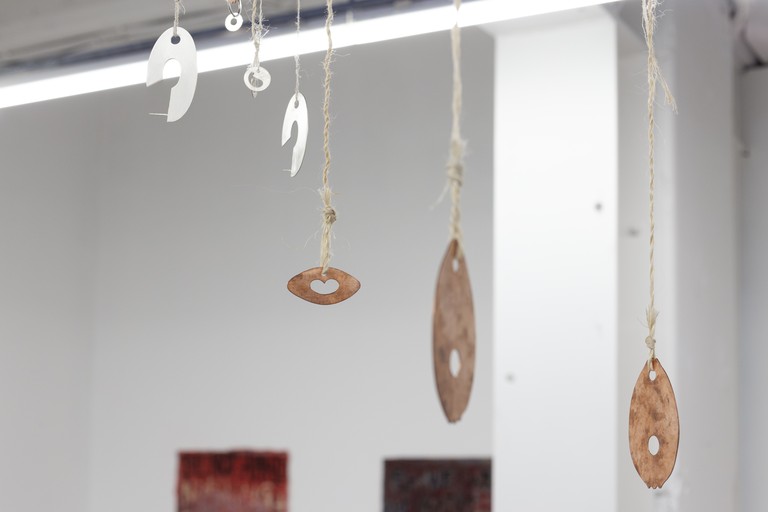
Aroha Matchitt-Millar, Tīwaiwaka takamiri turuma, he tangata kaikino (The spiteful, malicious person behaves like a fantail near the latrine, waiting for gossip as the fantail waits for insects attracted by the odour), 2024-2025. Tarp, muka, stirling silver, copper, Tīwaiwaka pelt, song thrush skin, acrylic paint, rotting harakeke. Photo by Cheska Brown.
I’ve been thinking about Tāwhiri a lot lately. I think about their ability to feel emotions, such as grief or rage. I think about how they must feel in the lull of Hine Pū te Hue and her ability to transmute grief. Sometimes navigating the space between Rangi and Papa can be like the vast ocean—a space where manu are the holders of that spherical knowledge we think about. Aroha Mattchit-Millar's work Tīwaiwaka takamiri turuma, he tangata kaikino explores that space between Rangi and Papatuuaanuku. Sometimes I like to conceptualise this as a fluid space, one where I can explore the full spectrum of what it means to be queer.
Harakeke, a tarpaulin tirairaka, and manu pōria hang like constellations. Manu pōria are both adornment and objects used to tame. I think about their use as colonial tools to domesticate and consider what their purpose is here. In this context, I imagine the manu using them as portals to code switch between the realms of Tane and Tawhiri or Rangi and Papa. Maybe it's the manu that help us heal. That teach us what liberation looks like. Hanging above remnants of rotting harakeke, the manu move effortlessly between fixed and fluid, being and non being, Te Ao Mārama and Te Pō.
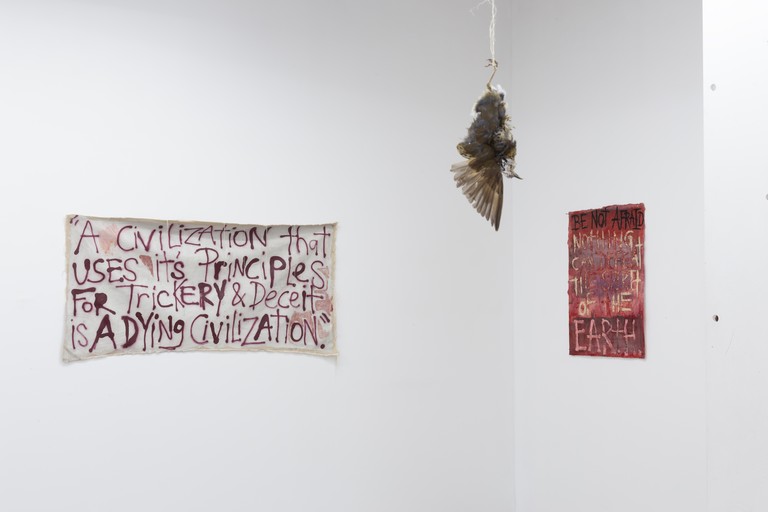
L to R: Aroha Matchitt-Millar, Tīwaiwaka takamiri turuma, he tangata kaikino, 2025. p. Walters, Césaire at Ihumātao, 2025. Acrylic, spray paint, dye on canvas. p. Walters, angels and faggots, 2025. Oil pastel, dye, acrylic on paper.
The colonial tongue is used for trickery and deceit. Te Tiriti o Waitangi is an example of this, with its promises made to be broken. p. Walters' words speak radical truths as an antidote for grief. They paint with urgency—red is used on the surface of their paintings as if they were painted with the life blood of Papatūānuku, from the depth of Kurawaka. Etched in the surface we read:
IF YOU WERE
OF THE WORLD
THE WORLD WOULD
LOVE IT’S OWN
But Because you are of the Earth, of the timeless realm
THE WORLD WILL
HATE YOU.
These words leave us in a spiral of self-loathing, how can we be of the earth and completely divorced from it? Is this healing? Next to this work is a taniwha with a tongue that looks wicked enough to utter these words. "He piko he taniwha" is a whakatauki from an iwi that I whakapapa too. It talks to the bends of the Waikato river and the taniwha that are kaitiaki.
In Slowing the Sun, Nadine Hura says "some losses will never be recovered; this has to be felt to be understood." Michael Stevens' recurring words draw us back to this truth. The truth is that many of our queer whanau died alone in their rooms, without that wraparound care that the artists are calling for. p. Walters' words ring true—if you were of the world, then it would would love you like its own. The truth often isn’t comfortable, it's confronting and liberating. An Ethics of Witnessing is an antidote for grief and reclaimed space of healing.
We recognise that "stone cannot be peeled off the roads to reform mountains but we can start to build things one stone at a time." We can not deny the physical abuse inflicted on Papatūānuku but we can honour the scars. The words of Michael Stevens threaded throughout this essay are amplified,
Am I healing right now? What more can I do?
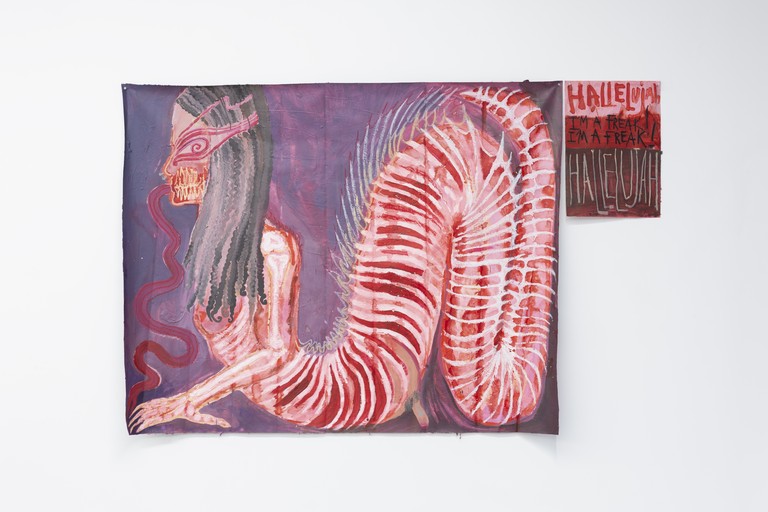
p. Walters, Red Dragon or Tarakona Whero, 2025. Oil pastel, dye, acrylic on vinyl. p. Walters, Mother's Daughter, 2025. Oil pastel, dye, acrylic on paper. Photo by Cheska Brown.
The cliché tells us that time heals everything, and in some ways, it might. But I start to ask myself, what more can be done when society pushes you to the margins? What more can be done when doctors leave you to die alone? The AIDS epidemic is a rich illustration of our collective failure to look after and care for the community. The colonial project would have us believe these truths about ourselves. Te Tiriti o Waitangi is an example of the physical abuse of bodies, maternal bodies, queer bodies, marginalised bodies, the fluid bodies that shapeshift across time and space. p. Walters’ works are a reminder of this.
HALLELUJAH
I’M A FREAK!
I’M A FREAK!
HALLELUJAH
Maybe healing is claiming space, maybe healing is remembering, maybe healing is giving voice to an experience, maybe healing is witnessing, maybe healing is mapping whakapapa, maybe healing is remembering who we are, who we want to be.
Am I healing right now? What is holding meback? What more can I do?
Is Randell (Tainui, Ngāti Kahungunu, Mangaia) is a multidisciplinary artist, curator, and educator whose practice is grounded in Indigenous futurisms, spatial storytelling, and whakapapa. Her work often takes the form of installation, writing, exploring the relationships between time, place, and identity through a distinctly Māori lens.
Israel teaches within the Mātauranga Toi Māori major, encouraging students to think critically and expansively about creative practice. She brings a bold, future-focused energy to her teaching, challenging conventional narratives, and fostering Indigenous innovation.