
Exhibition Essays
Enjoy's Archival Impulse
December 2025
Enjoy's Archival Impulse
Sophie Mephan
We humans can be rather sentimental creatures. We cherish and tuck away precious memories—the things, thoughts, objects, art, and writing that fill our days—in places deemed 'safe'. A box of postcards, seashells, Grandma's jewellery, baby teeth, and old journals placed under the bed, or sometimes it's the quarantined, fluorescent-lit stacks of an institution. If our archives represent what we wish to be remembered, to be saved from the awful fate of pasts lost and forgotten, they also represent our dreams for futures not yet known—we trace their outlines in the smoke of yesterday's fires. The 'our' and 'we' in these conversations are important: archives are inherently selective and can be undeniably biased. Historically, the archives of major arts organisations haven't spoken for everyone. And their current states are arguably little changed. But what might we find in the archives of smaller art galleries, such as artist-run or project spaces? Often fleeting in nature, where might we find their archival memories, if they are to be found at all?
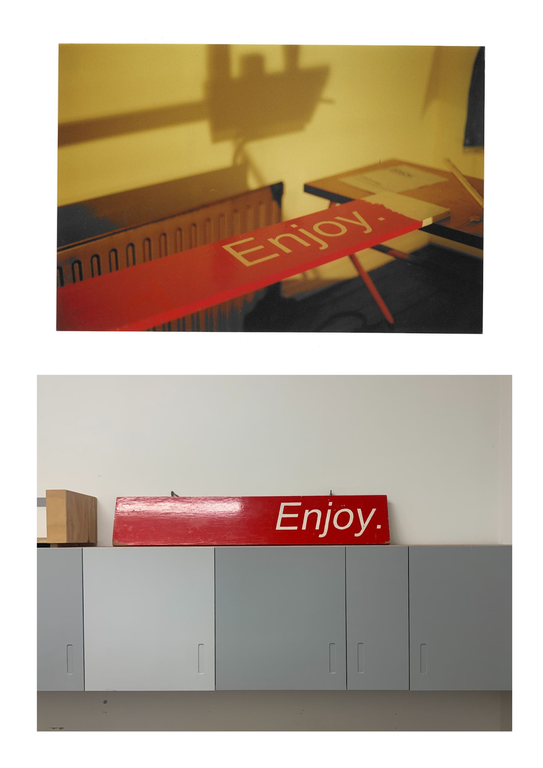
Enjoy’s original signage, c. 2000.
Enjoy Contemporary Art Space began life as an artist-run space, twenty-five years and three locations past. Today, Enjoy continues as an established organisation within Aotearoa's contemporary art scene, as a space to nurture emerging artists, curators, and experimental practices. There's a sense of the ephemeral, an ever-changing reflexiveness and potential, where Enjoy's size and independence offers something unique, a space for something new to emerge. But it is also true that the emergent is not necessarily antithetical to the historical.
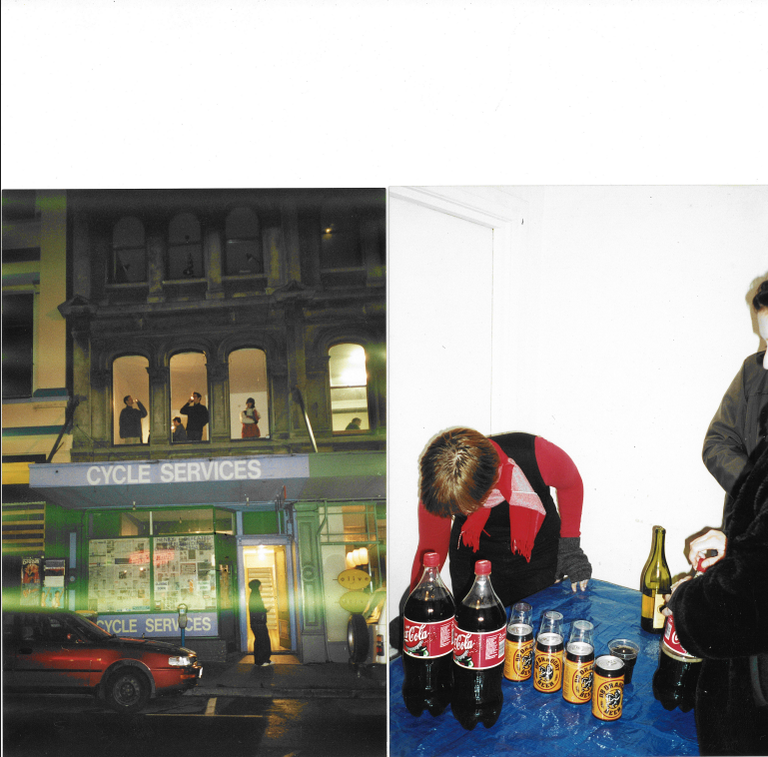
Enjoy’s first opening, early July 2000.
Enjoy is now situated on Left Bank, off Cuba Street, where you’ll find 18 pink cardboard boxes lining the shelves beneath the gallery’s front windows. Nestled within is a collection of documents—memoranda, exhibition ephemera, photographic film negatives, publications, a few sketches—together constituting Enjoy's formal archive. There are other boxes, other memories elsewhere too, perhaps stranded on outdated technology waiting patiently for someone to take the time to examine and file them away, but their addition won't ‘complete’ anything. The archive is (or, should be) an ever-ongoing project. We must think of the objects, documents, and artworks: whose stories our archives hold, but all the while think too about the frameworks and inherent systems of order and hierarchy within ongoing archival practices.
Traditionally, the archive was static: the archiving of the past fed into the chronological, linear understanding of time that underpins a Western worldview. But time does not pass gently or evenly for everyone, not least because there is little uniformity in its very conceptualisation. Time, here a/the Western concept, can be an act of colonial, classist, and heteronormative violence. The premature memorialisation of creative practices, such as those labelled 'traditional', within museum collections and archives, is just one example of the dominance of Pākehā time within these practices. "Terrible word, tradition!" Albert Wendt once said.1 Complicated word, contemporary?
Archiving within contemporary art spaces, particularly in small galleries or artist-run spaces, often arises from a sense of care and obligation to artists, with hope and belief in their futures. A platform, a leg-up, the space itself—both physical and public—is the first service a gallery can provide an artist. The second is as a vessel for memory, with an unspoken promise to remember. This responsibility often goes unsaid, as does the acknowledgment or acceptance that the gallery will ‘do their best’.
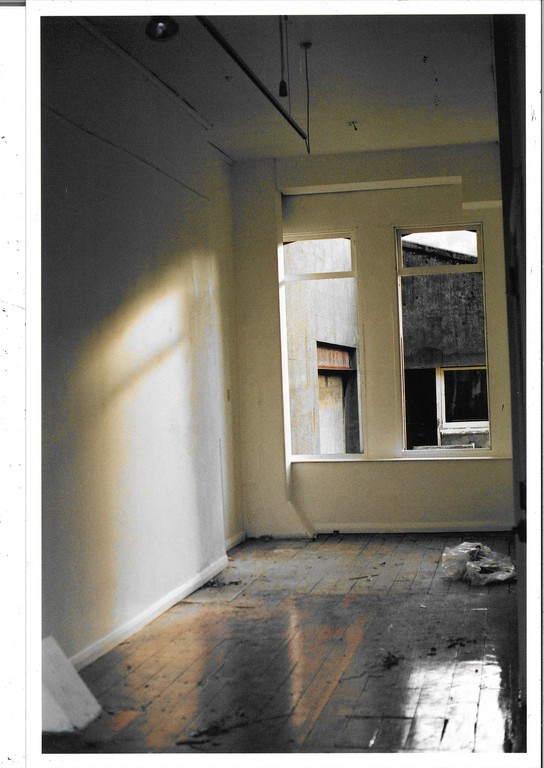
Installation view of a collaborative work by the Enjoy team, the first in the Viewfinder exhibtion series, 2000. Viewfinder (July–August 2000) was a series of shows that each lasted one week and revolved around the presence of the five windows at the gallery.
Organisations and artists are closely bound together in this act of remembering; indeed, both the concept and tangible reality of ‘community’ have played a significant role at Enjoy, but perhaps never so explicitly than in its earliest years. Enjoy emerged in 2000, prompted by a desire to make space for art to exist publicly beyond the confines of commercial demands in Te Whanganui-a-Tara Wellington. In Enjoy’s first series of exhibitions, known as the Viewfinder project, attention to the space itself was central. While initially five proposals were sought for (one for each of the five windows), six week-long exhibitions eventuated. The first to herald Enjoy’s arrival was a collaborative activation in which the windows were removed from the space. The wind swept through with leaves and litter, but so too did sunshine and fresh air; visitors likely leant from the gaping window frames to survey the view, voices travelled to the outside. Enjoy welcomed the city and situated itself here, with these people and places.
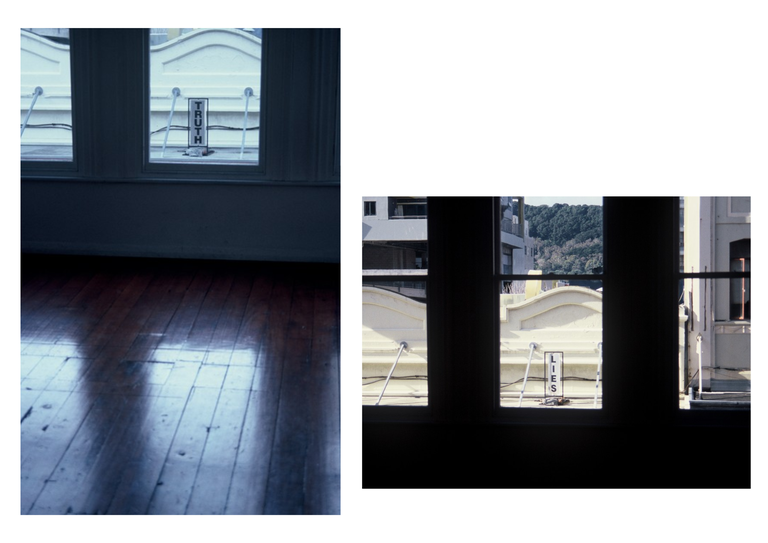
Installation views, Stuart Shepherd, Truth/Lies, 2001. An exhibition in the From Enjoy series (May–June 2001).
The next year, the From Enjoy exhibitions posed a series of installations in the surrounding cityscape, to be viewed from the windows of Enjoy. Despite having moved again twice since, a certain attachment to this part of the city—to Cuba Street’s shopfronts, passersby, and pigeons—lingers to this day.
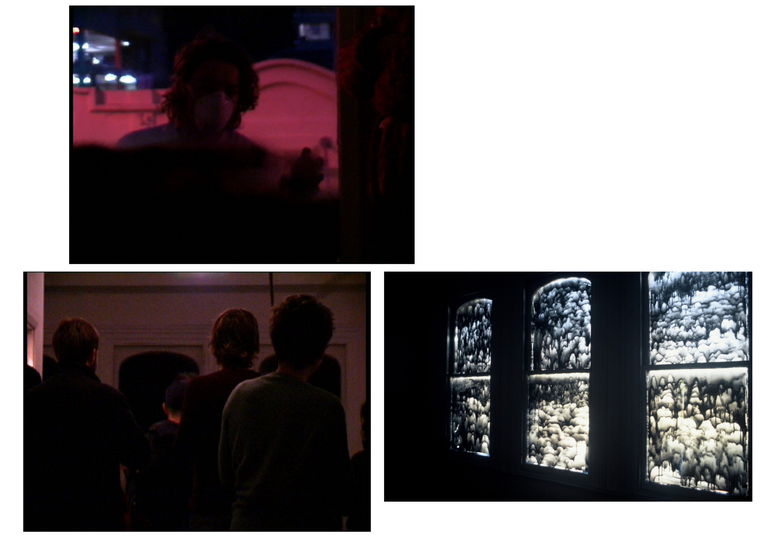
Performance documentation, Chris Clements, It’s Goodnight From Me and It’s Goodnight from Enjoy, 2001. An exhibition in the From Enjoy series (May–June 2001).
Many felt affection for Enjoy’s first location at 174 Cuba Street, especially following the relocation to number 147 in 2005. Fiona Connor’s installation, Inner City Real Estate 174/147, 2006, paid homage to the old space, recreating it wall by wall, with every window, the ornate column capitals outside, down to the gouges and chip marks, encapsulated entirely within the new space. I’m not the first to think about this work alongside archiving. In 2019, Imogen Simmonds, then Enjoy’s Archives and Library Intern, spoke with the artist about her installation, within which other artists’ work was also exhibited. Connor recalled the emotions of those familiar with the old Enjoy, and an experience of the “life-sized document” of a gallery for those who weren’t.2 I imagine a kind of uncanny nostalgia, an onslaught of warped memories.
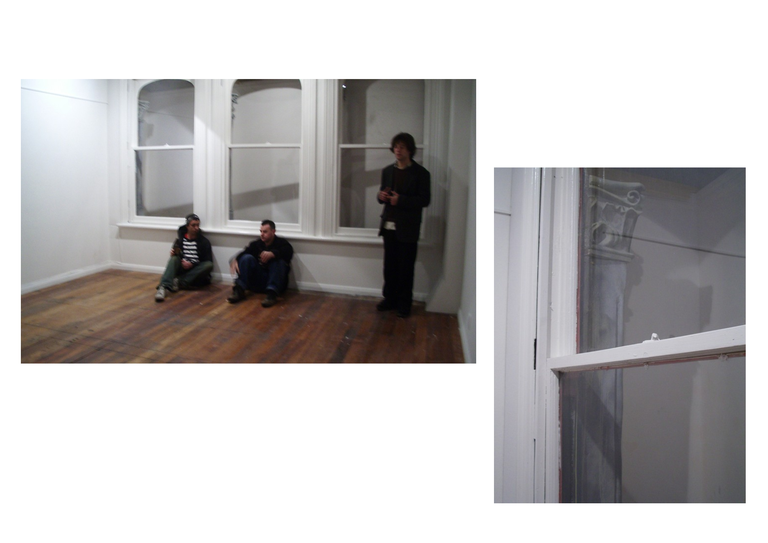
Installation views, Fiona Connor, Inner City Real Estate 174/147, 2006. Images courtesy of Jessica Reid.
But in fact, the reflective, archival switch had been flipped already in the early 2000s, after only three or so years of Enjoy’s existence. It coincided approximately with when ‘Enjoy’ became ‘Enjoy Public Art Gallery’, an indication of shifting intent and the name by which the space would continue to be known until 2019. The exhibition Enjoy Presents (2003) was a group show featuring the work of artists from within Enjoy’s community, and while a retrospective tone was evident in accompanying writing, ‘introspective’ may be another way to think of it. As part of an exhibition swap with other artist-run organisations around the motu, Enjoy Presents travelled to High Street Project and Blue Oyster in 2003, before returning to Enjoy in 2004, and later showing perhaps at Rm 103 (now RM), too. The Enjoy Five Year Retrospective Catalogue was published in 2005, and would be followed by two more iterations at five-year intervals. Each publication sought to encapsulate the essence of the previous years, filled with personal anecdotes and archival musings. The idea of community remained central to Enjoy’s view both within and beyond itself.
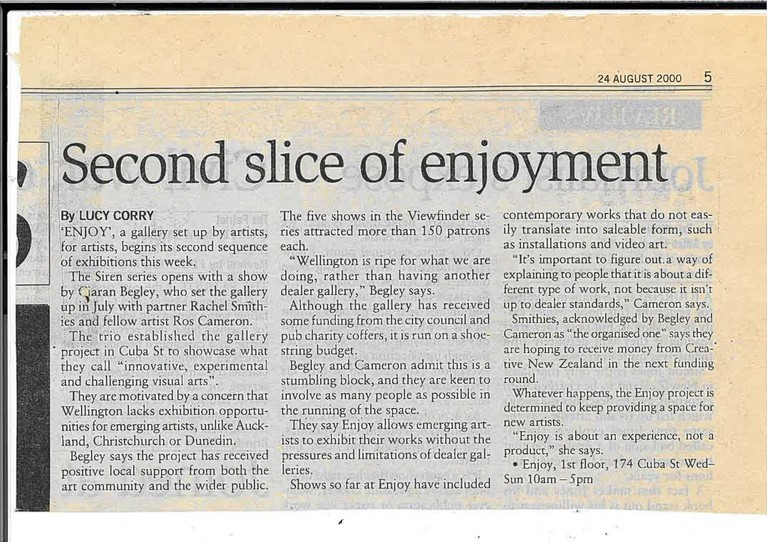
Lucy Corry, ‘Second slice of Enjoyment’, City Voice, 24 August 2000.
Enjoy is more established now, steadied and nourished by its past, and its historical self-reflexiveness emerges in different ways. Something else is needed from contemporary art spaces now. While the desire to be free from the whims of a local commercial art scene is no longer a driving force, it's with the same spirit of ‘seeing a need’ that Enjoy has evolved. As Emma Bugden writes, “The strength of an artist-run space is not whether it sticks around, but whether it activates and fills a gap, for a week or a month or a year.”3
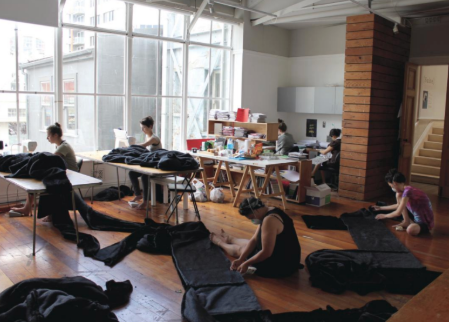
Mataaho Collective at Enjoy, 2013.
Bathed in the glow of recent international success at the Venice Biennale and the clamour of art institutions vying to exhibit and collect their work, Mataaho Collective are the golden children of Aotearoa contemporary art right now. In 2013, as recipients of the annual Summer Residency, Mataaho spent time at Enjoy and completed what perhaps could be considered their first artwork, Te Whare Pora, since acquired by Ngā Puhipuhi o Te Herenga Waka—Victoria University of Wellington Art Collection. As much as their website seems to suggest that Te Whare Pora was indeed Mataaho’s first work, I attempted to confirm this with another archive of sorts: their social media profile. While the collective’s earliest extant Instagram posts date to Kiko Moana and 2017, scrolling through their hundreds of posts was an infinitely more enlightening experience than I had expected. Colour and texture whirled by in a haze, and the everyday resonances of the collective’s works and practice rematerialised en-masse. I’ve since learnt that when Te Papa acquired Kiko Moana, they also ‘acquired’ Mataaho’s Instagram account (or, a screen recording of it).4 The Archive consumes an archive, but one that continues to grow and engage with the world.
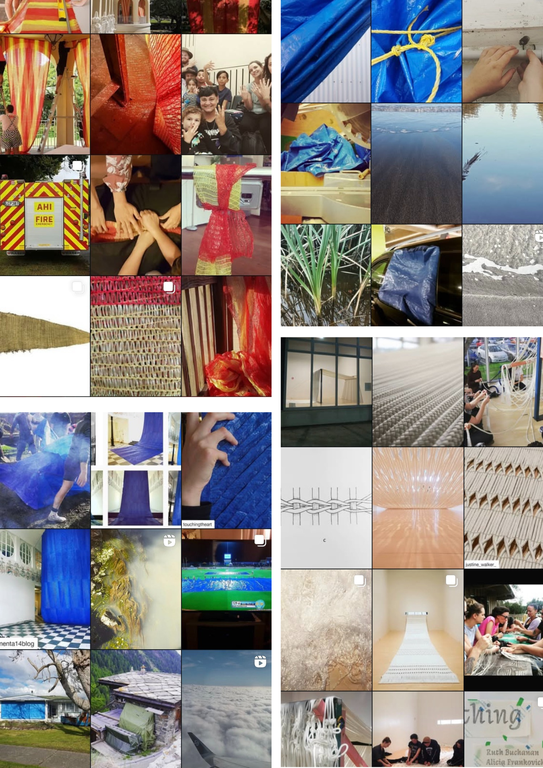
Screengrabs of Mataaho Collective's Instagram profile, @mataahocollective.
Apps like Instagram might hold a certain allure to the inner archivist within some of us, but our feeds and accounts remain susceptible to misrepresentation. We’re past pretending social media can be wholly ‘genuine’, and the veins of performance and protest are now engrained in these social and creative platforms. Perhaps this is a subconscious awareness that our present moments are no less subjective than the past is. There’s a certain fragility to social media, but it’s also one that more traditional archives should not be unfamiliar with.
Social media is not the archive that resides within a filing box in a climate-controlled room, but rather more like a silver locket on a fine chain. This is not to say that there is no value in thinking about social media as ‘archival’. If anything, the very instability of these platforms might offer a counter-archive to dominant narratives and modes of remembering. We know how rapidly information can be shared globally across social media, and how these platforms can show us what the mainstream news often won’t. This communal shouldering of responsibility is worth holding on to.
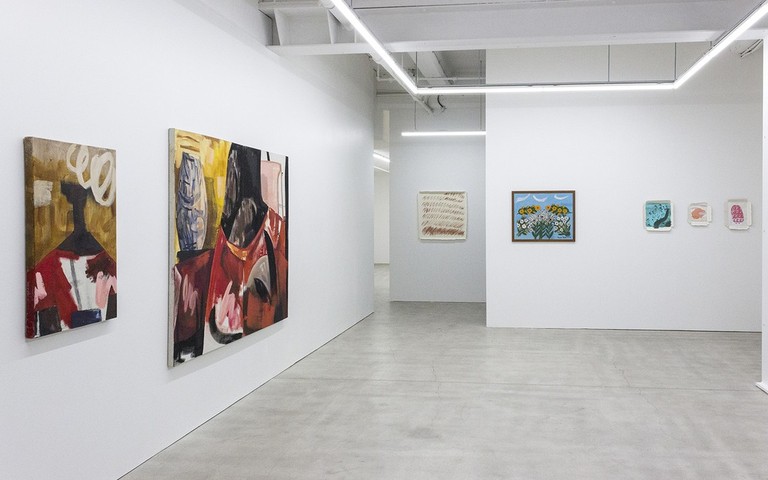
Installation view, This is a library, 2020. Works by Christina Pataialii, Teuane Tibbo, and Salome Tanuvasa. Photo by Cheska Brown.
In March 2020, on the eve of lockdown, the group exhibition This is a library opened at Enjoy, curated by Hanahiva Rose. This is a library featured the work of four artists: three ‘contemporary’ artists and one ‘historical’. Again, these words become slippery, and as temporal markers, they slide from linear origins. Alongside recent work by Christina Pataialii, Claudia Jowitt, and Salome Tanuvasa were a number of paintings by Teuane Tibbo, who was born in Vaimea, Samoa, in 1895 and died in Tāmaki Makaurau in 1984. One of Tibbo’s paintings in the exhibition, Making Tapa, 1965, belonged to Claudia Jowitt; she had found it in a gallery storeroom a few years earlier and was “lovestruck.”5 Meanwhile, Tanuvasa was able to paint in the gallery space itself, directly in front of Tibbo's paintings, the two artists in conversation through time.6
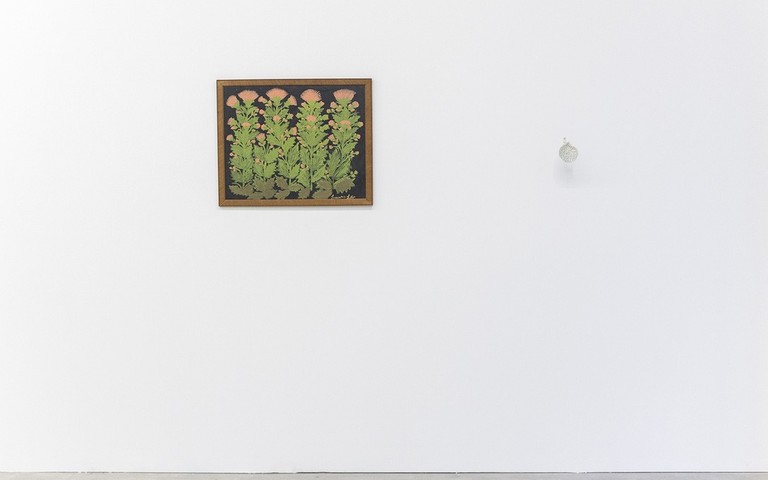
Teuane Tibbo, Opium Poppies, 1968, acrylic on board, Hocken Collections Uare Taoka o Hākena, University of Otago, Ōtepoti Dunedin, and Claudia Jowitt, Civa XI, 2019, acrylic, freshwater pearls, kanzawa coloured silver leaf on civa (mother of pearl) shell with custom hook and wall fitting. Photo by Cheska Brown.
Tibbo’s inclusion within Aotearoa and Moana art histories is arguably patchy at best. Yet despite the gaps in our archival memories of her life and artworks, she is still one of very few Pacific artists of her generation (and, equally, of the later era in which she began painting) who is remembered within the collective Archive. Writer Daniel Michael Satele summed up well the complications lingering around Tibbo's archival remembrance when he wrote,
“I want to highlight that when it comes to constructing (and reconstructing) a local Moana art history we are always working with an archive that has been created according to the biases of previous generations and the power dynamics of previous times. I believe that we should remain cognisant of the mechanisms that have preserved the memory of some artists over others. We should remain cognisant of the ways in which what appears to be ‘our’ history might have been shaped by individuals and institutions who aren’t ‘us’. To lose sight of these mechanisms, these shapers of what could otherwise appear to be objective history, would be the most profound loss this essay mentions.
Both what is lost and what is remembered are political.
Without romanticising or dismissing the gravity of the kinds of loss discussed here we should also interrogate the assumption that loss is bad. Or that all losses are equally so. I believe it is worth bearing in mind that a certain embrace of ephemerality and temporality runs deep in the cultures of Moana Oceania.”7
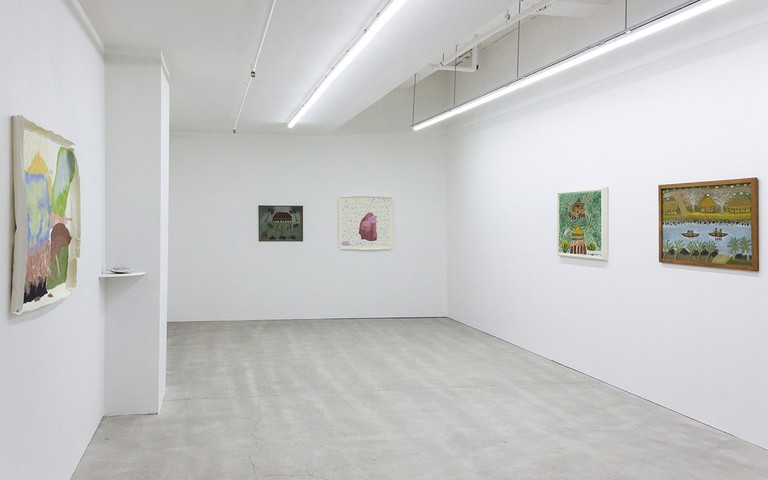
Installation view, This is a library, 2020. Works by Teuane Tibbo, Claudia Jowitt, and Salome Tanuvasa. Photo by Cheska Brown.
Within the context of Enjoy’s commitment to the ‘contemporary’, exhibitions such as This is a library, reframe our archival relationships, pulling artists and their practices from the Pākehā archive where they exist in moments thought to have passed—a history completed, done, written, fin—and show the very real, embodied spiralling of Moana temporalities. “From watching videos of Tibbo talking and from talking with her family, I think this is what she would want,” recalled Hanahiva Rose, “She wouldn’t want to be historicised. She was an incredible character with so much life, and so resistant to the idea of being old.”8
Ephemerality runs deep in histories of artist-run spaces, as it does within contemporary art. At times, the archives of these organisations can be just as ‘ephemeral’. For example, the archive at Meanwhile, another Te-Whanganui-a-Tara artist-run space, is, in parts, “missing.” And yet, there’s something not unexpected or unnatural about an archive with gaps, particularly for an organisation such as Meanwhile, which mirrors Enjoy’s own history in many ways. No doubt plenty of tangible memories reside on camera rolls, not to mention simply in personal recollection. Yet the urge to make permanent these moments remains.
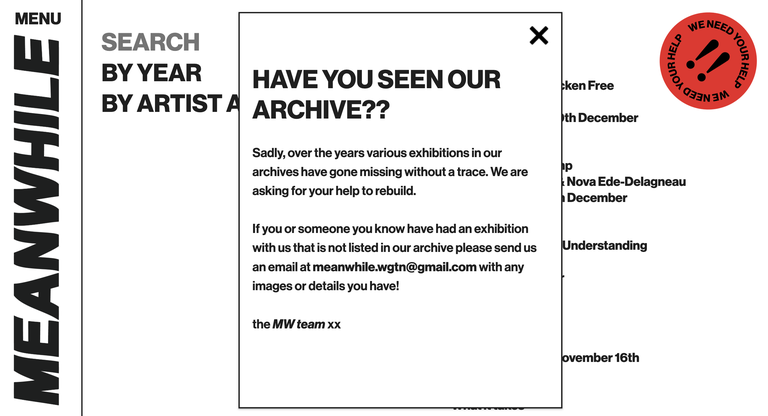
A screengrab of the Meanwhile website, https://www.meanwhilegallery.com/#/archive
And let's not forget, there are always other archives and archivists to help out; we remember collectively. Te Pātaka Toi Adam Art Gallery’s New Zealand Art Research & Study Centre, for example, holds numerous files on galleries with artist-run roots. Enjoy’s own Reading Room holds all manner of publications, from major institutions, small art spaces, artists, and projects. RM have digitised many years’ worth of photographs, and alongside making these photos accessible, they invite us to contribute to their archiving process. Satellites is an online platform focussed on supporting Aotearoa Asian artists and building a dedicated archive. As past Enjoy curator and current editorial director of Satellites, Emma Ng writes, “So much is still held in living memory by artists and curators—these are pieces of history to get a good hold of before they slide into shadow. There is plenty yet to say.”9
2025, the year marking Enjoy’s 25th lap around the sun, has passed with relatively little birthday fanfare. The emergent arts continue to flourish in the pavement cracks, and the archive expands alongside; rippling, embodied, and alive. Happy 25th birthday, Enjoy. May you have many more.
-
1.
Albert Wendt, quoted by Sean Mallon in "Against Tradition," The Contemporary Pacific, vol. 22, no. 2, 2010, p. 362.
-
2.
Imogen Simmonds, "Snapshot #2: Neither Here Nor There: Fiona Connor’s Inner City Real Estate 174/147," Enjoy blog, 2019, https://enjoy.org.nz/blog/2019/06/snapshot-2-neither-here-nor-there-fiona-connors-in
-
3.
Emma Bugden, "A Brief History of Artist-Run Spaces in Aotearoa," City Gallery Wellington Te Whare Toi blog, 2020, https://citygallery.org.nz/a-brief-history-of-artist-run-spaces-in-aotearoa/
-
4.
Te Papa Tongarewa, "Kiko Moana," Taonga Māori Collection, https://collections.tepapa.govt.nz/object/1623719?page=1&rtp=1&ros=1&asr=1&assoc=all&mb=c.
See also Matariki Williams, "He Hononga Toi: Ten Years with Mataaho Collective," ATE Journal of Māori Art, vol. 3, 2022, p. 56.
-
5.
Nansi Thompson, "Love letters to Savusavu," Art News Aotearoa, issue 183, Autumn 2019, https://artnews.co.nz/claudia-jowitt-autumn-2019/
-
6.
"Bridging Histories, a Conversation between Hanahiva Rose and Ben Lignel," Handshake Project, 2021, https://handshakeproject.com/wp-content/uploads/2022/06/Handshake-Writers-programme_Interview-with-Hanahiva-Rose.pdf
-
7.
Daniel Michael Satele, "Forgotten Artists and Lost Artworks," in Lana Lopesi (ed.), Pacific Arts Aotearoa. Tāmaki Makaurau Auckland: Penguin Random House New Zealand, 2023, p. 42.
-
8.
Lana Lopesi and Hanahiva Rose, "Rising Star: Teuane Tibbo, Ani O’Neill and Salome Tanuvasa," Arts News Aotearoa, issue 191, Winter 2021, p. 70.
-
9.
Emma Ng, "Rattling the Shelves," Satellites, issue 1, 2024, https://www.satellites.co.nz/magazine/issue-1/rattling-the-shelves