
Exhibition Essays
Like portraits
May 2026
Like portraits
Ardit Hoxha
First, a little mound of sand, gently patted, followed by a pair of eyes and a mouth that smiles ever so slightly. At the edge of the frame, there are glimpses of the artist, Lily Worrall, who appears and disappears through a series of jump cuts. Suddenly, the rough outline of a face is given hair (clumps of seaweed), followed by a set of teeth (brown algae). Another quick cut, glasses—and voilà! A silly little portrait.
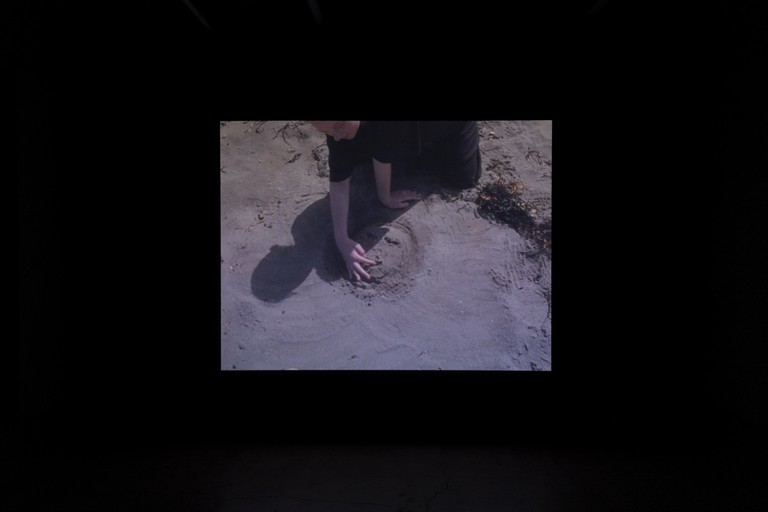
Lily Worrall, moon irons wings (still), 2026. Photo by Samson Dell.
With this opening gesture, Worrall introduces moon iron wings, her new still- and moving-image work, developed during and after a 2025 residency at the Rita Angus Cottage, the historic home of a painter best known for her self-portraits. Working from this history as a point of departure, Worrall explores the genre, drawing a very loose outline of herself through film, as she does with her ‘sandface’. The resulting work is a dizzying montage, split through multiple narrative points and temporal markers—one that, rather than providing direct representations of the self, offers instead found objects: the stuff of the family archive—old memorabilia, home videos, and even the graves of ancestors. As this found-material and sand portrait makes clear, the image of the self that Worrall conjures does not rely on unique craftsmanship or the singularity we associate with artists; her images instead tease, even gently mock, the idea of mastery, of style, of the self, and so on.
Worrall’s turn to filmmaking is no coincidence here, a practice that draws on a list of collaborators—in this instance, voice actors, cinematographers, and even translators. Alongside footage Worrall shot herself, much of the film’s content has been sourced from her family, including the silent Super 8 film made by her father and his parents, which Worrall has spliced and given a diegetic soundtrack. Elsewhere, the film uses still photographs documenting the film set Worrall’s parents helped construct in the early 1980s: a fictional cemetery where they also first met. In drawing on this material, Worrall traces remnants of herself in the stories of others, memories she has not directly experienced. This refracting of the self is emphasised by the film’s commentary, which, in a kind of ventriloquism, defers Worrall’s storytelling to loved ones who speak in her stead, sometimes in a foreign tongue.
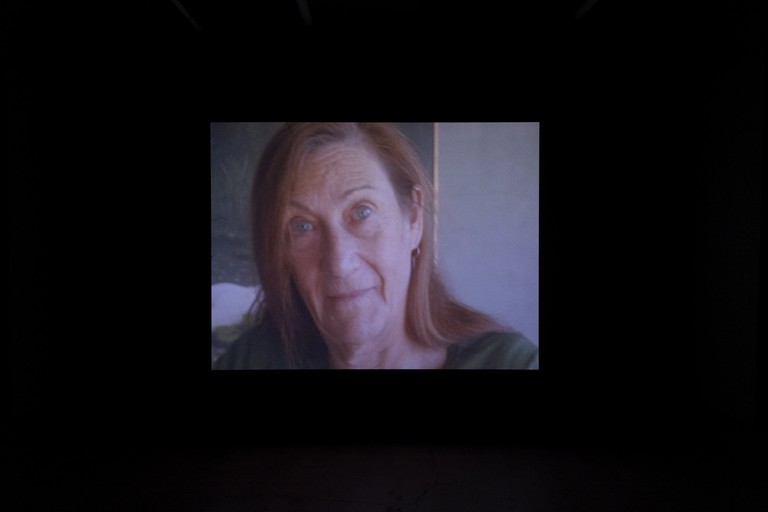
Lily Worrall, moon irons wings (still), 2026. Photo by Samson Dell.
Worrall’s self-portrait is also delegated, a task she lays at her parents’ feet, who, in one of the film’s sequences, draw her. In this rare example of continuity editing, close-ups and mid-shots frame her parents, Peter and Amanda, as they sketch, looking up every now and again to meet the camera’s gaze—the gaze of their life model. The skilled sketches contrast sharply with the ‘sandface’ Worrall offers in her opening, as if to suggest that a gaze from elsewhere might be a necessary supplement to the subject.
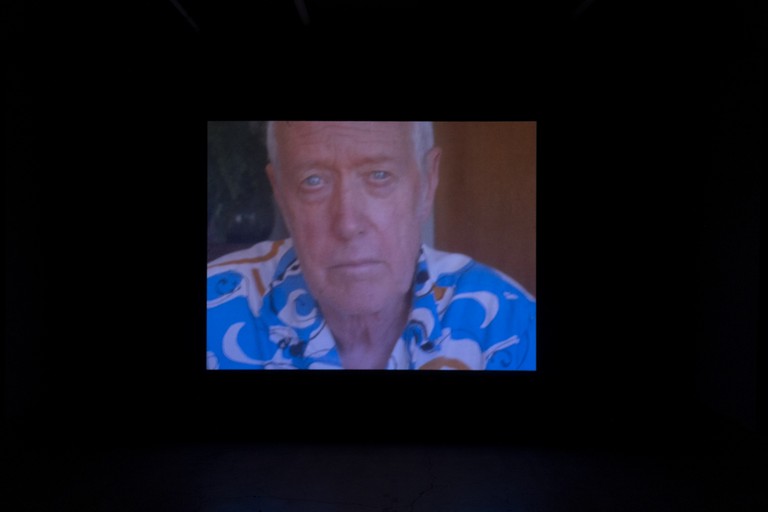
Lily Worrall, moon irons wings (still), 2026. Photo by Samson Dell.
While Worrall relies on found material, or self-portraits made by proxy, none of these sources offers a complete picture, nor are they taken as given. In fact, the material is always reworked: her camera frames her parents’ drawings, while old material gets cut up and rearranged. The contents of the images—the discernible faces (Amanda, Peter), figures (mother, father), settings (cemeteries), and actions (set building)—are also questioned by the film’s voiceover, which repeatedly raises the interconnected concepts of trust, belief, and truth.
The clarity of the content is also undermined by the use of grainy analogue film that softens, by digital footage stretched to its limits, and by faded and overblown pictures dirtied by pixels, light leaks, emulsion scratches, dust, and so on. In the emphasis of these accidental blips and image stains, Worrall seems to side with what the semiotician Roland Barthes describes as the “punctum” over the “studium”: the point at which the photograph fails, over where it is legible.1 She finds herself, in other words, not in the historical scene the photograph witnesses or fixes in place, qualities that, according to Barthes, are knowable and studiable about a photo, but rather in the details that puncture and disrupt the image’s smooth comprehension.
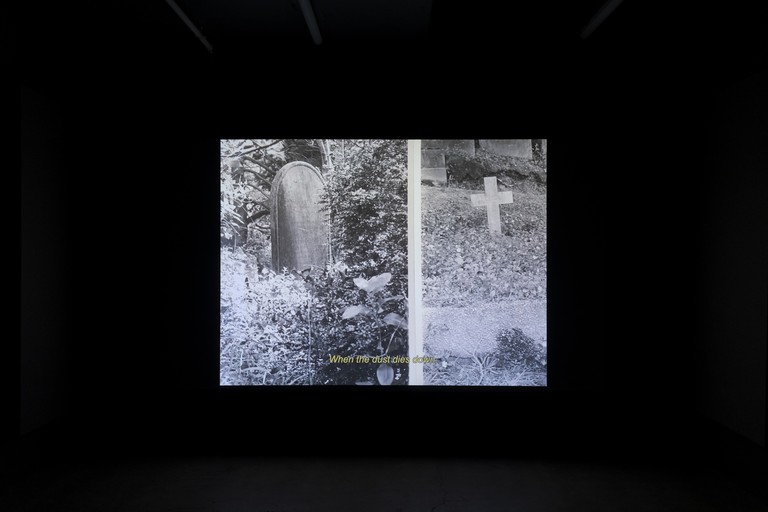
Lily Worrall, moon irons wings (still), 2026. Photo by Samson Dell.
Worrall’s iconoclasm, her aversion to images, becomes clear in these pictorial wounds, an aversion that transforms this self-portrait into as much a warning as a representation of the self. What else should we make of the tombs and cemeteries that recur throughout the film, other than foghorns that caution what fixity can beget? Note, the still photography used to depict these sites, which extends Worrall’s caution to the camera itself—a device that, in prolonging a given moment, embalms it, “freezing the shifting phantasmagoria which is our actual experience.”2
But Worrall’s photographs and footage fail to congeal, and her editing, which cuts back and forth between still and moving image, does not allow anything to rest, including the graves, whose eternal slumber is also stirred by whispering soundscapes. From this puncturing, Worrall’s self-portrait undergoes a kind of dialectical inversion, in which, to avoid the subject's death—by way of frozen tableau—the bruising of the image is embraced instead. This might explain why we see no clear image of Worrall, who, in lieu, appears as scratches, an accident, a sting, a speck, a prick that shoots out… like an arrow, from what is otherwise a two-dimensional surface.3 Lifting off from the image, flying and wing-ed, she takes the form of an uncapturable surplus, a phantom that grazes the scenes and objects she passes through and by, leaving, in her wake, a trail of partial-images.
-
1.
Roland Barthes, Camera Lucida (New York: Hill & Wang, 1981) 26, 27.
-
2.
A turn of phrase by Joan Didion from The White Album, which refers to writing not cameras, but suits me just as well (New York: Farrar, Straus and Giroux) 11.
-
3.
Synonyms/metaphors for the punctum in Camera Lucida, sourced across pages 26, 27.