
Exhibition Essays
Talking home
May 2026
Talking home
Ardit Hoxha
In what is otherwise a stark white cube, Latamai Katoa presents her home, or at least her own version of it, in an installation comprising a series of photographs and objects. What happens if it’s broken? she asks rhetorically in her title, suggesting that something has gone awry in this re-arrangement of the whare.
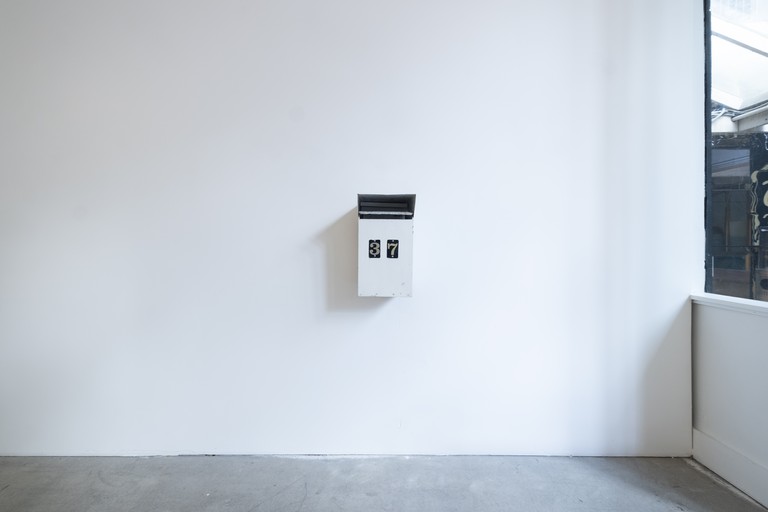
Latamai Katoa, Littered Box (Letterbox), 2026. Photo by Samson Dell.
The home Katoa presents is clearly not functional; it is not habitable. If this is what’s broken about it, then Katoa is partly to blame for drawing on the tradition of the readymade, repurposing household objects into artworks that strip them of their original function. For example, the letterbox sourced from the house where she grew up, which, now placed in the gallery, no longer receives letters and can’t flag the correct address. Or, the curtain that drapes across the space, which is similarly out of use, no longer concealing anything. Not to mention the two personal ornaments: a display key received on the occasion of Katoa’s 21st birthday, and the other, a wooden hoe (paddle) received by the artist’s sister, who carved it—gifts presented here to strangers with no access to the objects' intimate sentiments or stored memories.
Katoa's home loses its primary function in this repurposing, the boundaries it draws to keep the external out, whether gust, rain, or people. Lines that once demarcated the internal from the external—a sliver of fabric drawn for privacy, a public address for private letters—collapse into one. A similar blurring of boundaries can be seen in the cardboard floor plan Katoa has included of her family’s house, which takes the shape of an unstable stage, its lines coarsely sketched.
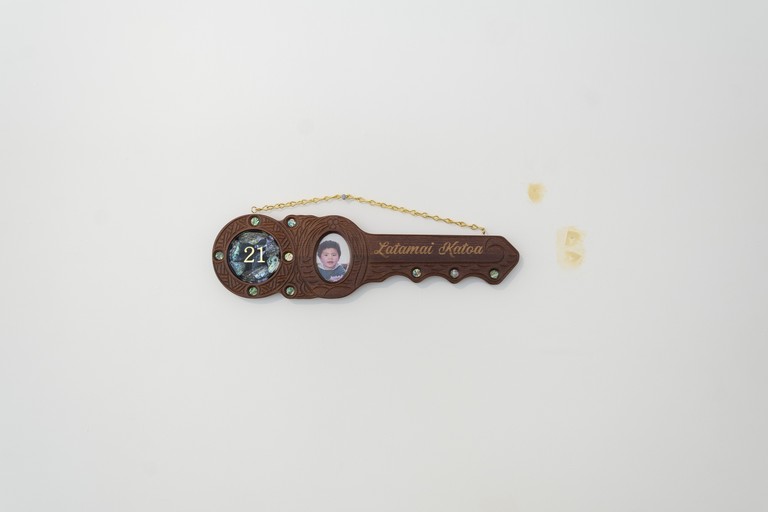
Latamai Katoa, Untitled (21st Key, gifted by Wheke Fortress), 2026. Photo by Samson Dell.
The theme of porous boundaries continues in the photographs Katoa has named Untitled (Gestural Altercation Studies), a series that documents the far-from-perfect DIY plastering done around her family’s whare. Close-up perspectives that emphasise gaps that still need filling, rips, and cracks where the wall has splintered. The rough lines and putty work take on the texture of wrinkles and skin, as the walls of the house are uncannily anthropomorphised, a subtle nod to the gothic home where inanimate things come alive and familiar objects are turned strange, unfamiliar.
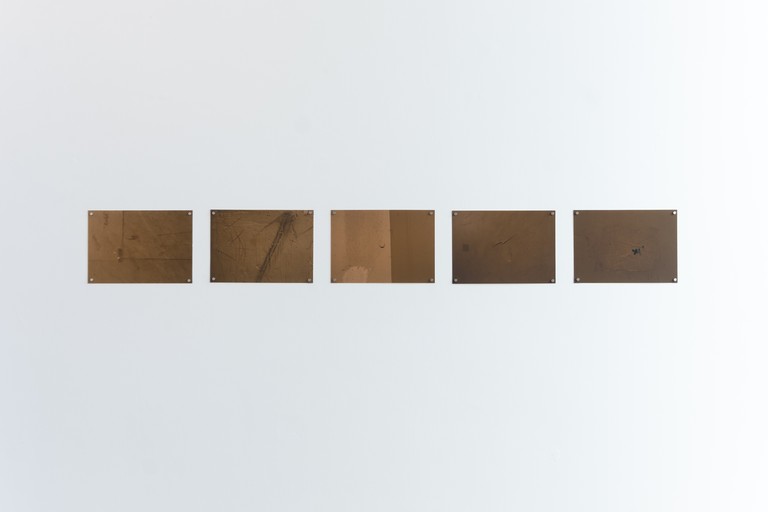
Latamai Katoa, Untitled (Gestural Altercation Studies), 2026. Photo by Samson Dell.
But Katoa seems unfazed by this haunting; her photographs playfully trivialise the attempts at restoration. In one photo, a tiny smiley face on a patch of lumpy putty beams back a small, teasing grin. It’s hard not to read these images against the elevated place DIY culture holds in New Zealand, so defining that, apparently, “it's in our DNA!", a pastime so revered that it has itself become a spectacle. Consider the property makeover genre of reality television that saturated our airwaves in the noughties and 2010s, shows featuring derelict properties that young couples/families are tasked with doing up and, in some cases, flipping for greater or lesser profit.1
That this lauded national practice is often accompanied by another favourite local custom—property speculation—should not be forgotten. To borrow the words of cultural theorist Misha Kavka, the vernacular DIY project is an “anti-gothic clearing agent,” one which expunges “the traces of (architectural and personal) history… not unlike the earlier settler project of clearing, and claiming, land.”2 The goal here is not so much to restore as to make new—in order to forget what came before. Katoa resists this impulse to ‘repair,’ a tradition that, far from embracing the home as a site patinaed by personal sentiments, or by the stories of others who may have once lived there, instead scrubs it all away, giving it a fresh lick of paint to cover all manner of ills.
In opposition to such repair, Katoa presents a practice of sublimation, one that makes peace with the unassimilable qualities of the home—the things that houses normally try to keep out, the unfamiliar, the strange, the stranger. What is significant about this rendering of the home is that the product of its scabs and porous walls is not the dread that usually accompanies the uncanny, but rather a knowing smile. After all, this is neither a fearful, gothic house, nor a gamified, reassuring shelter, but instead a creative knotting together of what is both familiar and unfamiliar about the whare. To draw on the title of the sister project from which this exhibition emerged, this is a Nostalgia Archive, a loved yet painful, bittersweet homecoming. It is in this spirit that these objects become artworks, keys enlarged into ornaments, the home’s blueprint made into a kind of stage, the curtains its theatrical dressing. Ultimately, it is to this sublimated site—the non-place of the gallery—that Katoa’s letterbox leads.
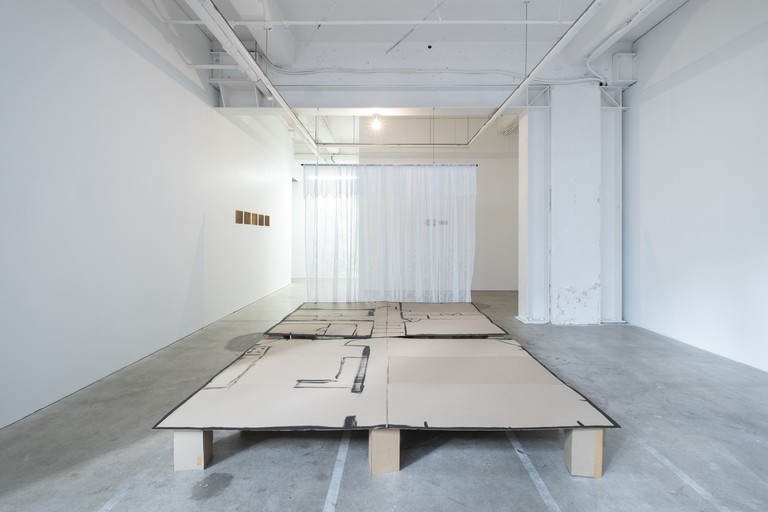
Latamai Katoa, What happens if it's broken? 2026. Photo by Samson Dell.