
Exhibition Essays
Old emblems, new homes
December 2025
Old emblems, new homes
Brooke Pou
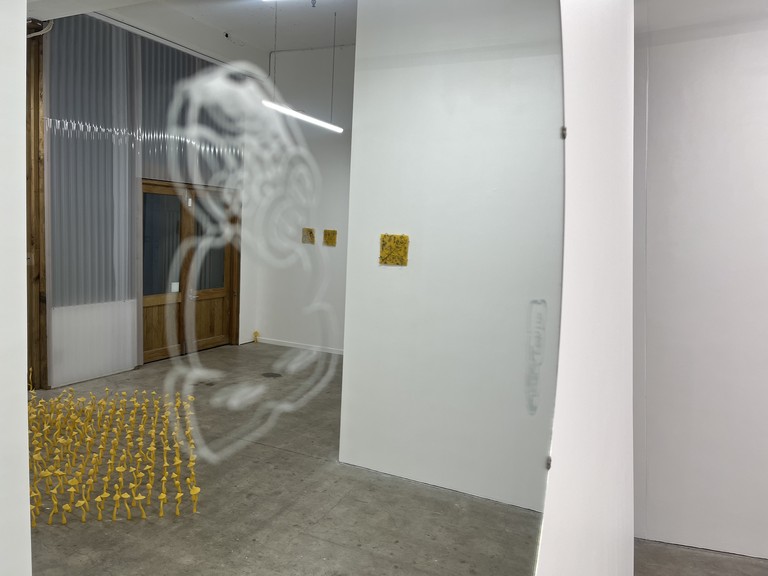
Tessa Russell, Waitirohia & George Turner, Out of the Scene, into the Fever, 2025.
On 24 October, Enjoy opened two exhibitions: Waitirohia by Tessa Russell and Under the Pasture by George Turner. Russell’s ongoing interrogation into He Whakaputanga o te Rangatiratanga o Nu Tireni me Te Tiriti o Waitangi and Turner’s exploration of nationhood, identity, and decay have noticeable similarities. Beyond the more obvious thematics the two motifs that I keep returning to in each exhibition are the hei tiki and the New Zealand flag.1 They are both iconic emblems—one of te ao Māori and another of the nation of New Zealand.
For Waitirohia, Russell made a new series of works on vintage mirrors, each engraved with hei tiki, that are a tribute to the moment when the artist saw her reflection after receiving her moko kauae for the very first time. According to Russell, that experience “changed everything.”2 For so long, she had felt out of place in her own skin, but in that moment she saw someone she recognised but had never met. The engravings on these mirrors, much like the engraving on Russell's skin, represent tūpuna Māori. An experience at an exhibition of pounamu in which many hei tiki were catalogued as ‘iwi unknown’ left Russell feeling uneasy. The tiki is an esteemed symbol in te ao Māori and toi Māori in particular. For centuries, variations of this form have been found across Aotearoa. As with anything Māori, the origins of this symbol depend on which hapū or iwi you ask. One idea is that Tiki was the first man, made by Tāne using uku, thereby forever linking his form to humankind. It makes sense then, that wāhine trying to conceive wear these taonga. If hei tiki do aid in conception, then they must be considered a potent symbol; what is more powerful than giving life? Tiki represent the lives of our tūpuna, but also our tamariki. They are ancestors and descendants. In Waitirohia, these unknown ancestors have a home.
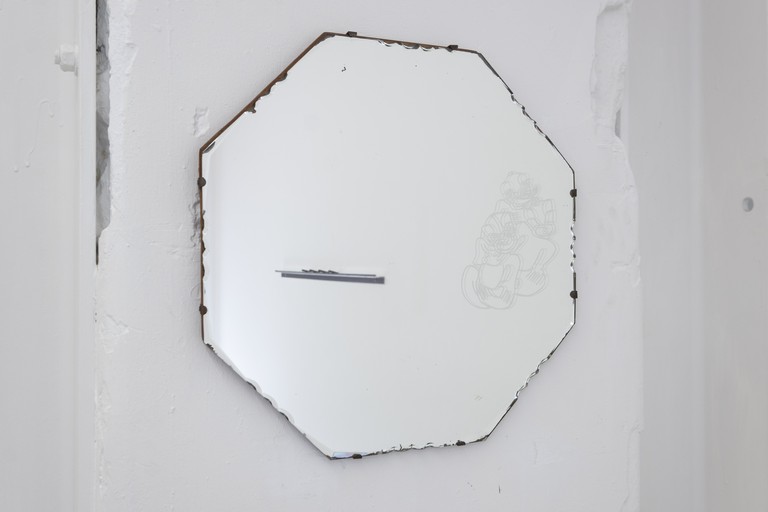
Tessa Russell, Waitirohia, 2025, installation view. Photo by Samson Dell.
Tirohia, translating to ‘inspect’ or ‘gaze upon’, offers an entirely different way of looking—slower and more purposeful. To tirohia into the wai means to acknowledge “yourself as part of the waters you are gazing into, waters that are your tūpuna.”3 Tūpuna Māori would, naturally, most often gaze into their own awa. It is this act of active introspection that interests Russell, who wonders how looking not only into the water, but your own water, impacts your wellbeing. What does it mean, then, to display Waitirohia in an art gallery, so far removed from the artist’s awa? A connection to that exhibition of hei tiki pounamu who were also removed from their people and homes? A commentary on urban migration? There are thirteen mirrors in this exhibition. Some only feature one or two tiki. Others have clusters. They are spaced out from one another and stacked on top of each other. If there's any rhyme or reason to Russell’s engravings I can’t see it. She chose to engrave these tiki on pre-loved mirrors. They came to her with histories of their own, and will now go on to the new homes of their buyers—tiki and tangata together again.
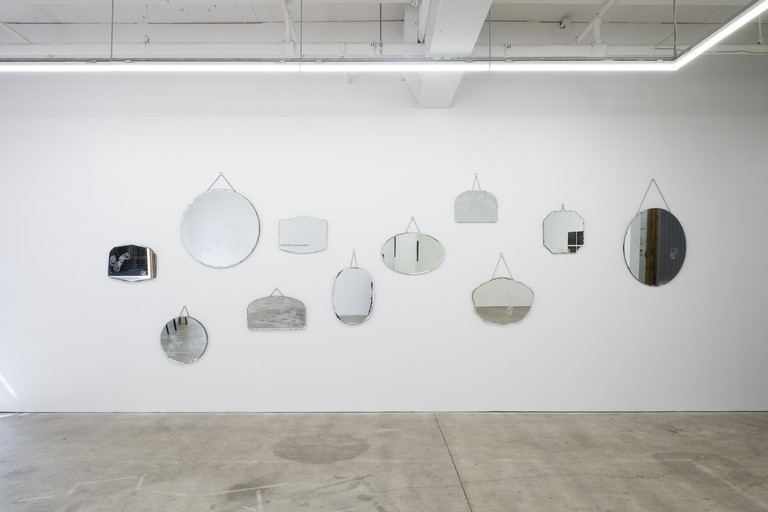
Tessa Russell, Waitirohia, 2025, installation view. Photo by Samson Dell.
Though they are separate exhibitions displayed in distinct spaces, audio made from field recordings for Turner’s new film Refugia.exe links them together. I find it serendipitous that Russell wanted to, at the last minute during installing her show, add tūī birdsong she had recorded as a soundscape to accompany her work. I also found it to be a relief that we were simply able to turn Turner’s audio up and let their audio bleed out into the entire gallery.
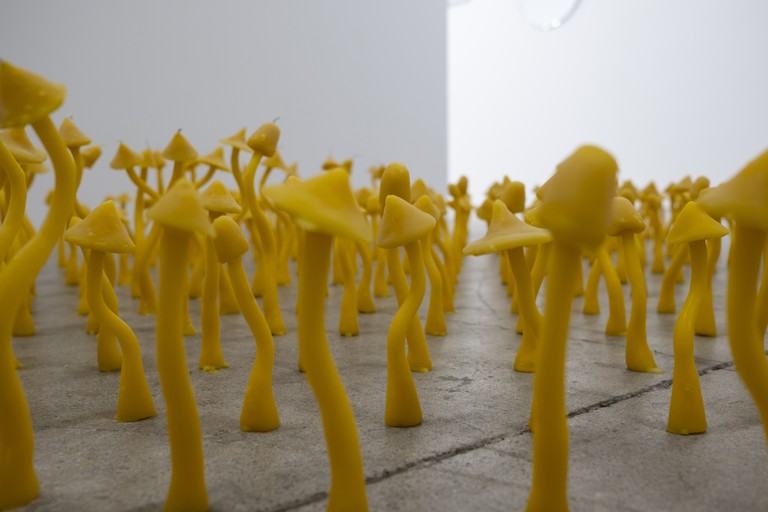
George Turner, Out of the Scene, into the Fever, 2025, detail view. Photo by Samson Dell.
In the installation Out of the Scene, into the Fever Turner warps the New Zealand flag almost beyond recognition. Using bright yellow beeswax, the artist moulded 256 mushroom-shaped sculptures, which have been pressed into the gallery’s floor in the shape of the New Zealand flag. Looking down at this orderly formation of fungi—so unlike that of their wild counterparts—we are prompted to question if this emblem represents who New Zealanders are today. Various flags have been used to represent this country. Our current Blue Ensign with a red Southern Cross has been in use since 1869, though it was only officially adopted in 1902. Turner has removed the most obvious attributes of this nation’s flag—it is not made of fabric and does not feature blue, red, or white. Replaced with bright yellow beeswax, this flag is fragrant. Each individual piece is waxy and smooth. There are a few variations in size, so that the Union Jack and Southern Cross stand slightly taller and larger than the rest, though they remain difficult to discern. Importantly, these are also the components of the work with a wick, turning them into candles. It is significant that this flag is installed on the floor. Earlier this year, Diane Prince’s Flagging the Future (1995) was shown in Activist Artist, curated by Gina Matchitt. The artwork, a New Zealand flag stencilled with the words “Please Walk On Me”, was well-received in the exhibition’s first iteration at Pātaka Art + Museum (2 November 2024 — 9 March 2025), but the subject of complaints and protest that ultimately led to its removal when the work travelled to Suter Art Gallery (10 May — 5 October 2025) and theft at Te Whare Toi o Heretaunga Hastings Art Gallery (1 November 2025—14 February 2026).
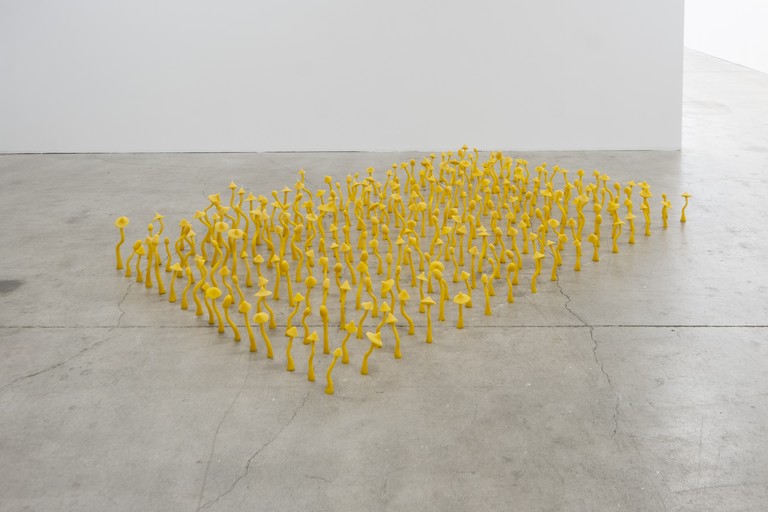
George Turner, Out of the Scene, into the Fever, 2025, installation view. Photo by Samson Dell.
To some people, any perceived disrespect to the New Zealand flag is unacceptable. Those insistent that their grandfathers fought for the flag often choose to unthinkingly repeat an American catchphrase and ignore the ugly history of this nation. Here, where Hōne Heke—the first Ngāpuhi rangatira to sign Te Tiriti—repeatedly felled the flagstaff at Kororāreka. Where Tūhoe activist and artist Tame Iti shot a flag (purported to be Australian). Where it is illegal to alter, display, destroy, or damage the New Zealand flag “in any manner with the intention of dishonouring it.” Unlike Prince, who invites, or even goads manuhiri to engage with Flagging the Future by literally asking us to walk on the artwork, Turner’s work is subtly sardonic—after all, if flags are made to be flown, candles are made to burn. It is already a deconstructed version of the flag, but burning will unravel Out of the Scene, into the Fever even further. Once melted, I assume Turner will scrape the beeswax up and reuse it in another form. Like Russell’s mirrors, it will find a new home.
-
1.
This essay focuses on the artworks Waitirohia and Out of the Scene, Into the Fever. For more text on the other works in these exhibitions, please visit https://enjoy.org.nz/waitirohia & https://enjoy.org.nz/under-the-pasture.
-
2.
Correspondence with the artist, 4 October 2025.
-
3.
Ibid.