
Exhibition Essays
These are Addressed to You
June 2026
These are Addressed to You
Jess Clifford
These are Addressed to You gathers the work of Bas Jan Ader, Christian Dimick, Yana Nafysa Dombrowsky-M’Baye, Abigail Aroha Jensen, Sharon Kivland and Sarah Rose—artists whose practices span painting, sculpture, sound, performance, writing and moving image. The exhibition borrows its title from a 2025 book in letters by participating artist and writer Sharon Kivland. It explores what it means to address and to be addressed, to correspond and to be in correspondence with. As the definition of a letter encompasses both the alphabetic and the epistolic, these are practices that are attentive to the potentials of language and its transmission. Within this understanding of correspondence, address is slippery, unstable—a crack that appears between sender and receiver. Works by Bas Jan Ader and Sharon Kivland begin in the form of a postcard dispatched across oceans, Sarah Rose and Yana Dombrowsky-M’Baye use sound to cast absence as something heard as well as felt, and both Christian Dimick and Abigail Aroha Jensen, in different ways, engage with expanded forms of whakapapa as sites of transformation and catharsis. What emerges—through repetition, fiction and accumulation—might be considered ways of navigating distance, both proximate and far.
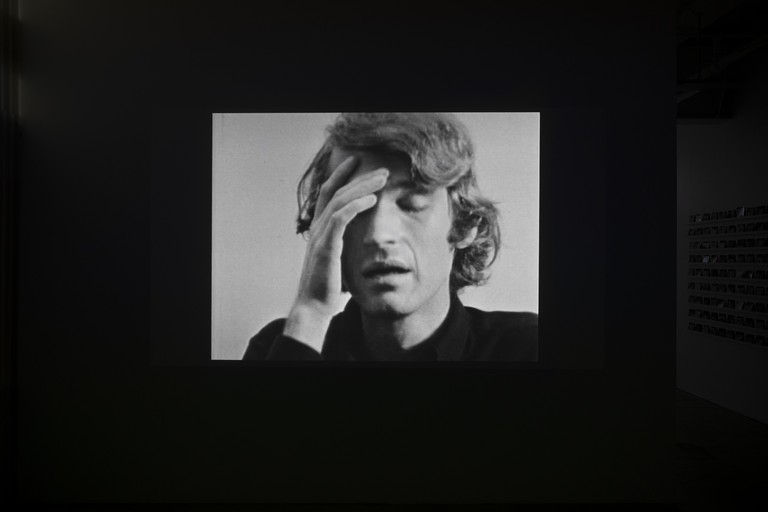
Bas Jan Ader, I'm too sad to tell you, 1970–71. 16mm film transferred to digital video, silent, 3:22 mins. Courtesy of La Colección Jumex, México. Photo by Samson Dell.
© The Estate of Bas Jan Ader / Mary Sue Ader Andersen, 2026 / The Artist Rights Society (ARS), New York and Resale Royalties Aotearoa, New Zealand. Courtesy of the Museo Jumex and Meliksetian | Briggs.
I’m too sad to tell you (1970-71) is a performance and 16mm film in which Dutch conceptual artist Bas Jan Ader cries on camera, in close up and over a single long take, seemingly wracked by a sadness too powerful to put into words. He screws up his face, clenches his teeth, closes his eyes, his eyelids tremble, he tries to control his breath. He lowers his head and holds it in his hands. For a moment he fights back tears, then they stream down his face once more. His anguish is palpable, yet mediated. No reason is given, nor relief.1 The work is also a postcard with the dated inscription—“Sept. 13 1970. I'm too sad to tell you."—that depicts an image of the artist racked by tears. A still extracted from an earlier version of the film, since lost, Ader, who had then been living near Los Angeles for a number of years, printed the image on postcards and sent them out into the world, including to his brother and close friends in Europe. The work on view documents a second iteration of the performance, filmed in Amsterdam the following year.
Ader does not explain why he is crying, and though his sadness is convincing, the effect is staged, self-conscious. Lacking any psychological motive, there is no way to interpret his behaviour—which remains detached, formal, an exaggerated emotional state that exists on the level of the image. In I’m too sad to tell you, as across his body of work, Ader deploys the aesthetic strategies of conceptual art to affective ends: he weaves an image-language of feeling. The work is often read as a response to the machismo of the Hollywood-influenced Los Angeles art scene of the late 1960s and early 1970s, a performance that defies conventional masculinity. Writing in 2000, several years before the advent of social media platforms, the critic Jan Verwoert described Ader’s practice as “a decisive missing link between the formal strategies of historical conceptual art and the core interest of current approaches to the constructive nature of subjectivity.”2 A version of the film now circulates on YouTube, a digital multiplication of its ‘original’ distributed postcard form. Yet what remains is only ever the repetition. Addressed to both everyone and no one, Ader’s performance remains abstract, a linguistic formula akin to the valediction or complimentary close of a letter—with love. Flickering between pathos and melodrama, the true register of Ader’s gesture, by post and on screen, stays out of reach.
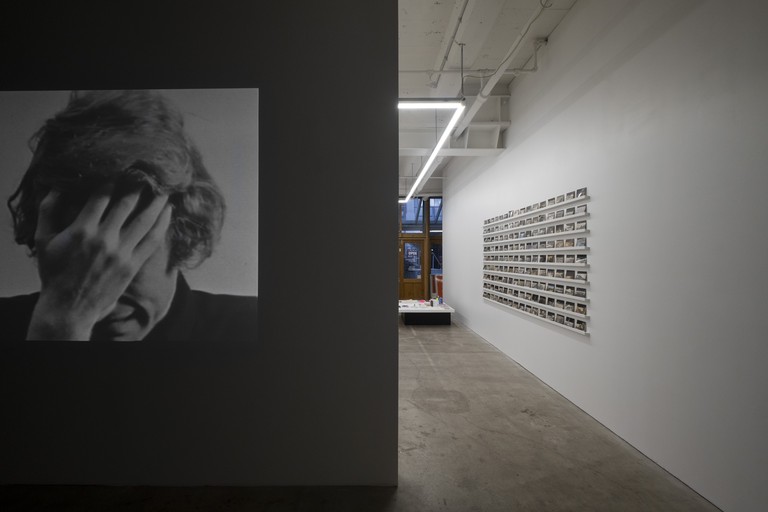
These are Addressed to You, 2026, installation view. Photo by Samson Dell.
Sharon Kivland’s practice engages with the structures of language, psychoanalysis and desire, often drawing on literary and archival sources to toy with the instability of address and slippages between author, reader and subject. Several of her recent publications mobilise correspondence as a site in which subjectivities are formed, displaced and reimagined—her ‘novel’ Abécédaire (2022) draws on the format of alphabet primers to ventriloquise associative links between the biographies of women whose names start with the letter A: Anna O., Anna F., Annie D., Annie E., each written over the course of an analytic hour: “None of them are me. The words are not my own; the words haunt me and inhabit me,” Kivland notes.3 In Envois (2025), Jacques Lacan’s canonical seminars on language, desire and the gaze become love letters received by the author over the course of an (imagined) affair. These are Addressed to You (2025), from which this exhibition takes its name, is a series of twenty-six digressive texts written as daily letters to Kivland’s editors. Of the latter, critic Gabriel Levine Brislin writes that the “letters, like all the most pleasurable examples of personal correspondence, are provisional and improvisatory, following associative chains with a speculative air. They position writing as primarily an act of connection, a reaching out beyond our immediate horizons.”4
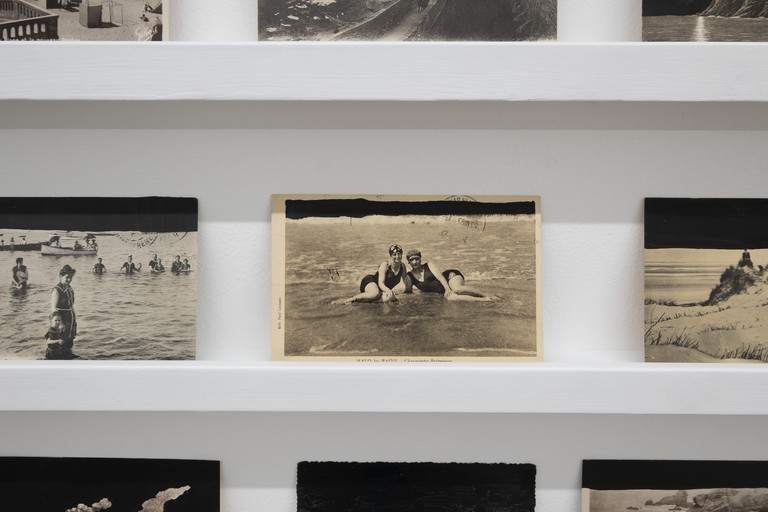
Sharon Kivland, Mes horizons, 2013–ongoing, detail view. Found seascape postcards, Indian ink. Photo by Samson Dell.
Many of Kivland’s projects follow a constraint or system, and Mes horizons (2013–ongoing) is similarly procedural: a series of found and collected vintage seascape postcards, which have been modified with layers of Indian ink that black out the skies. In this work, the horizon line—typically a site of orientation, projection and distance—is both preserved and destabilised, as the removal of the sky interrupts the image’s capacity to situate the viewer. As Kivland herself describes, “The ink, erasing or filling the horizon, oscillated between obliterating and enhancing the view. The surfaces were cracking, a raised patina. Recto/verso, one does not ever see the two sides together.”5 A postcard is a memento, a souvenir—from the French ‘souvenir’, to remember. This function displaced, what remains is a surface marked by repetition and subtle variation, intimating a more fragile relationship with memory and its eventual disintegration—as if the horizon might collapse under the weight of the ink. In one sense, the work is bracketed by its conceptual gesture—postcards found and kept, an addition that is also an erasure. In another, Kivland’s own relationship to the conceit has, as waves do, ebbed and flowed over the sands of time. In their seemingly endless accrual and repetition, the postcards mark out both dailiness and the horizon line that looms for us all. The artist invites viewers to pick them up and attempt to decipher their faded inscriptions: “A turn of the card: hazard, destiny, accident, coincidence.”6
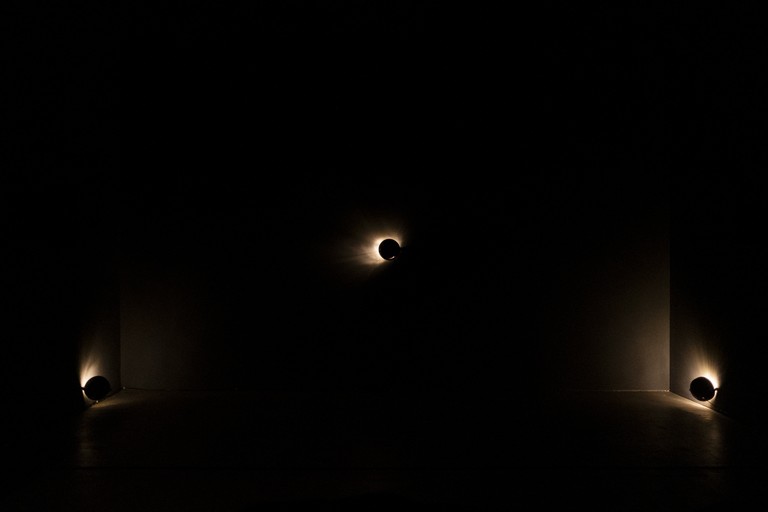
Sarah Rose, Redolence, 2026. Quadraphonic sound installation with field and electromagnetic recordings, modular synth, voice, motorbike lights, reactors. Photo by Samson Dell.
Sarah Rose’s multi-channel sound and light installation, Redolence (2026), is composed of insect recordings sourced from citizen science platforms alongside intimate vocal references, electromagnetic interference and other non-human sounds, and explores how the intimacy of listening might attend to ecological interdependencies. The work builds upon Rose’s interest in the body of letters exchanged between American conservationist Rachel Carson (author of the landmark 1962 book, Silent Spring) and her friend and lover Dorothy Freeman. Reading the pair’s correspondence, Rose became aware of their latent queer subtexts, moments of coded intimacy and oblique address that exceed the letters’ apparent function. For Rose, their shared observations of changing environmental conditions functioned as an emotional exchange, suggesting other modes of relation held just beneath the surface of language. With description as intimate currency, Rachel and Dorothy’s attention was always to that which was overlooked—a blade of grass silvered with dew, leaning under the weight of a spider's web, and only visible through a slight trace of light. “Attention is the rarest and purest form of generosity," suggests philosopher Simone Weil.7 In Redolence, Rose replies in turn, staging a collective response that renders audible others’ acts of deep listening as a corollary to this attentive observation of the natural world. The listener is placed within a specific act: careful attention to a world under chemical load and the impulse to share what is heard with someone elsewhere.
Insects form a central sonic presence within this field, understood here as beings formed within electrified habitats, where signals are transmitted, disrupted, followed and echoed. A cicada’s continuous sonority inflects the space with its cyclical absence. A moth navigates through overlapping systems of attraction and interference, following chemical traces through the same charged air in which pheromonal chemistries circulate alongside toxic dispersals. Electromagnetic recordings and synthesis extend listening beyond the threshold of human perception; voice enters not as narrative authority but as another vector of relation—one signal among many. The title of the work draws on the porosity of both sound and scent, permeable atmospheres that communicate through an exchange between body and environment. Redolence suggests that to listen is also to sense what cannot be fully captured: traces of chemical presence, the residue of movement, the persistence of interference. Listening becomes an expanded form of attention, attuned not only to sound but to the conditions that carry it. As Weil defined generosity as an act of deep, unselfish listening—the radical suspension of the self—Rose’s contribution underscores a broader inquiry into how we orient ourselves toward others; correspondence extends to mutual responsiveness, a being in-relation.
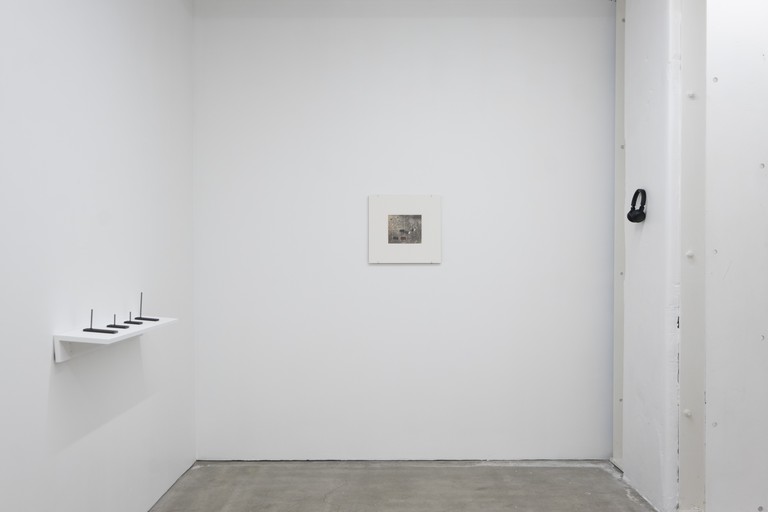
Yana Dombrowsky-M’Baye, three baskets woven from a memory recalled, 2026, installation view. From left to right: patinated steel mounts (inscribed); silkscreen print on EMIGA invoice for Sumatra benzoin (1951), double-exposed with an image of the estate of Jacques-François Roger; nocturnal soundscape of the artist’s great-aunt’s bedroom in Sénégal interwoven with archival audio recordings, 19:43 mins, loop. Photo by Samson Dell.
Yana Dombrowsky-M’Baye’s three baskets woven from a memory recalled (2026) emerges from an evolving speculative fiction that traces the eighteenth and nineteenth century French colonial trade in gum arabic—a substance extracted from acacia Senegal trees of north-western Africa—through the figure of an imagined painting conservator. Comprising an ambient soundscape that hums with the sonic affects of Sénégal, a series of steel mounts inscribed with text, and a layered screenprint grounded in a piece of transactional ephemera, the installation lingers within the resonance of colonial frictions. It builds upon and also refracts the terrain of Dombrowsky-M’Baye’s recent films, in which the artist maps her matrilineal ancestry to Sénégal from her current home in France.8 Speaking through various interrelated and biomythographic protagonists, the artist-narrator inhabits different characters as a way to dissolve the boundaries between history and inheritance, memory and fiction. She summons the voices of women across time and space: a painting conservator recalls a dream in a strange bedroom; women gaze out mutely from the walls of a museum; the signares—women perceived to gain property, status and power through marriage to European men during French colonial West Africa from the late 1600s to the early 1900s—peer over their balconies at dusk; the artist’s own aunts and nieces whisper back from the shadows.
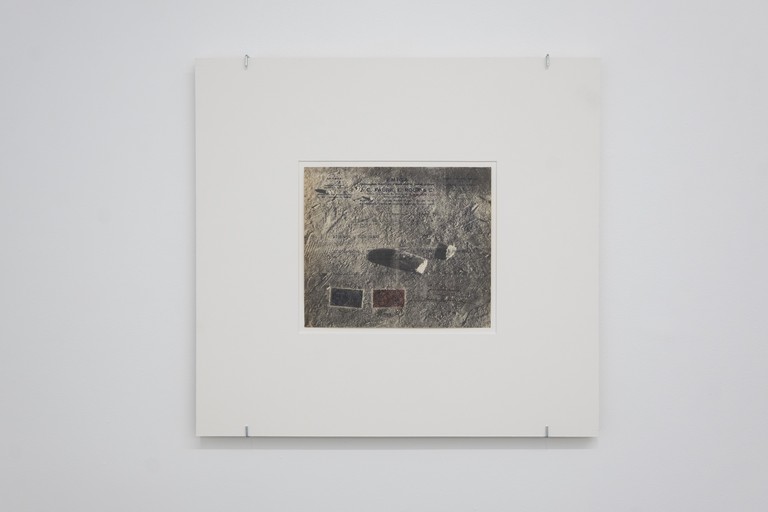
Yana Dombrowsky-M’Baye, three baskets woven from a memory recalled, 2026, detail view. Silkscreen print on EMIGA invoice for Sumatra benzoin (1951), double-exposed with an image of the estate of Jacques-François Roger. Photo by Samson Dell.
In this ambiguity of subject position, Dombrowsky-M’Baye draws on writers such as Toni Morrison and Saidiya Hartman, authors who use fiction as a mode of reconstruction or restoration of memory, a tool to fabricate what has been lost to the erasures of history. In her essay, ‘Venus in Two Acts’, Hartman calls this methodology ‘critical fabulation’—a narrative technique that stories the ‘might have happened’. It is an “impossible writing that attempts to say that which resists being said,” she writes; an account of history written both “with and against the archive,” often bending time, rendering the past, present and future coterminous.9 For Dombrowsky-M’Baye, writing is an embodied practice, and here the intimate, handwritten text—a letter, a fiction, a script—has been performed from memory. These are also voices that inhabit; this is a process of enunciation. The registers of image and sound likewise enact temporal and spatial collapse: the artist layers an invoice written by the EMIGA corporation (Marseille Establishment for the Importation of Gum Arabic and Colonial Products) with an image taken at the estate of Jacques-François Roger, the first colonial governor of Sénégal. In contemporary and archival recordings, a sonic telescoping attunes to the rhythms of trade, leisure, worship and rest. Across its tripartite structure, three baskets woven from a memory recalled enacts what filmmaker and theorist Trinh T. Minh-ha describes as a “critical distance from myself”—a use of ‘I’ that paradoxically renders it inseparable from a wider sense of address. As Minh-ha writes, “I am not i can be you and me;” infinite layers.10
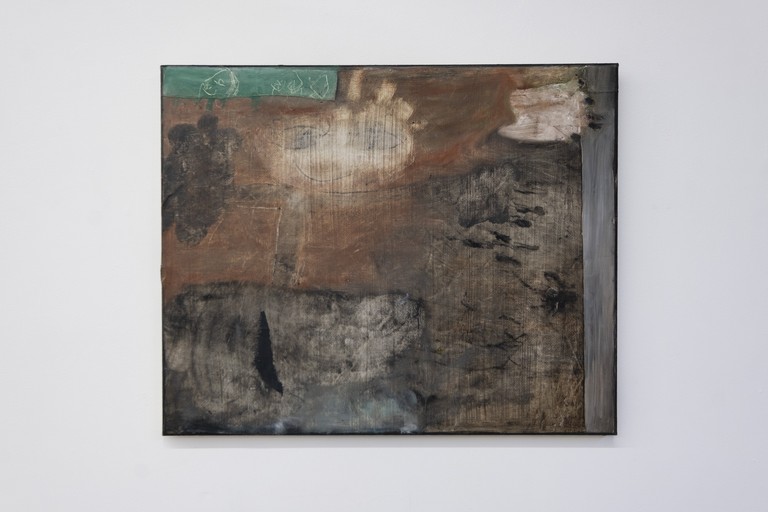
Christian Dimick, Remedial Action #3, 2026. Oil, pastel and charcoal, PVC on canvas, 450 x 550 mm. Photo by Samson Dell.
Christian Dimick’s painting practice uses the visual language of childhood as both source and method. Often returning to his own early drawings, Dimick’s works unfold as layered surfaces in which areas are reworked, obscured and rearticulated over time. Moments of exuberance and spontaneity sit alongside traces of hesitation, erasure and return. This sustained attention to mark-making is informed by the artist’s research into drawing and its relationship to childhood development, where gesture precedes language and meaning emerges through repetition, play and bodily engagement. Dimick describes his process using this vocabulary, as a form of ‘fortuitous realism’—a developmental stage in child psychology where a child begins to notice the resemblance between some marks or scribblings they have made and an object in the world around them, to which they assign meaning. The phenomenon marks a transition in conceptions of representation: although very young children know that pictures can represent ‘real’ things, they do not initially think that they can draw representations. Once a child believes they can represent life through images, drawing shifts from gesture to symbolic expression.11 Within this framework, drawing precedes representation, in the way that poet Lisa Robertson suggests poetry exists before and outside of language: “For me, language derives from poetry; poetry does not derive from language. Poetry is the first language, in childhood and in the culture.”12
In Remedial Action #3 (2026), plumes of ochre and charcoal are scraped back to reveal a figure and its echo: a scritch-scratch of marks onto and into the roughly textured surface. To the right-hand side of the frame, vertical brushwork suggests a curtain, as in a theatre, or on stage. The scene appears to float slightly, edged by a thin black frame. A process of decoding ensues, as our minds try to solve the composition like a puzzle. In the artist’s words, the work “explores the potential actions a child might take to mitigate the dysfunctional family unit and cool the air in their own improvised, reactive way. The adult's hand at the top right of the frame opens the curtain and creates an environment where the figure must perform.”13 For Dimick, the act of painting is a way of working through memory without resolving it. The canvas operates as a kind of palimpsest, holding together multiple temporalities—a site of correspondence between different versions of the self, where gestures made in the present respond to and reconfigure those of the past.
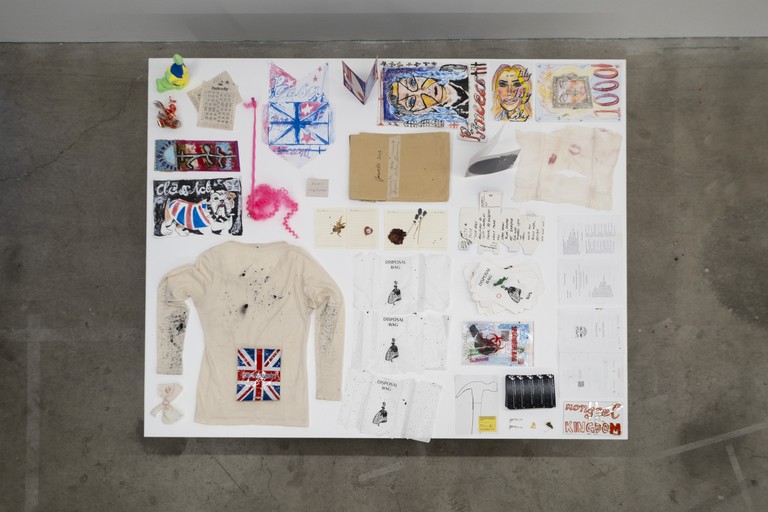
Abigail Aroha Jensen, Transit Holiday, 2026. Foam clay, leaving card, synthetic hair, solder, pressed flowers, heart lolly, napkin, lipstick, sharpie, mcdonalds toy box, foil ribbon, found crossword, specimen bag (assorted), cobbler ticket, toy soldier, rubber band, brown paper envelope, masking tape, gun charm, bear charm, cherub button, paper sanitary bags, merino long sleeve, “london girl” make up applicator kit, golf tee, souvenir packaging, animal blessing service sheet, holiday card, black house paint.
Drawings: Bonnie Blue, coloured pencil, sharpie, liquitex napthol crimson, birthday card, soldered copper glass; Lily Phillips, coloured pencil, sharpie, liquitex napthol crimson, envelope; NorthWest, coloured pencil, watercolour, gouache, kandahar drawing ink, liquitex napthol crimson, liquitex phthalocyanine blue, masking tape, minor attractions exhibition sheet; British Bulldog, ink, twink, coloured pencil, watercolour; Peasant Crest, envelope, coloured pencil, liquitex phthalocyanine blue; Poppy III, glass, soldered copper tape, london girl nail varnish, deka transparent glass paint, one shot enamel, eyelash glue, golecha cherry henna paste, flashe couleur opaque; Mongrel Kingdom, glass, soldered copper tape, one shot enamel.
Photo by Samson Dell.
Abigail Aroha Jensen presents an installation of material ‘harvested’ over the course of her time in residency at Gasworks in London. In two separate but interwoven displays, she externalises a process of exchange between Aotearoa and the United Kingdom, as well as the uneasy coexistence of an itinerant studio practice and everyday life. Jensen describes her work as produced from a “weaver’s mindset,” and, as harakeke might be processed, shredded and bound, so too are the material components of her practice subject to continuous processes of accumulation, disassembly and metabolisation.14 Her work appears playful yet is underpinned by a rigorous conceptual framework that seeks to connect the philosophies of psychoanalysis and Te Ao Māori, and asks: how might customary knowledge and contemporary materials interact? How could the tikanga of weaving be adapted to the ways we consume media in an ever-untethered digital era? The two works on view have developed from Jensen’s sustained engagement with archives—from international museum collections of taonga pūoro to more ephemeral, digital repositories, including her own social media channels. Transit Holiday (2026) is a stockpile of materials sent back to Aotearoa from London. In particular, it records the afterlife of a public event at her studio, in which an installation of disposable sanitary bags collected from ScotRail train toilets were inadvertently splattered with drips of black paint, following a failed experiment with a balloon. Among other drawings, a glass tile bearing the emblem of the Union Jack and the text ‘Mongrel Kingdom’ manifests a clash of symbolic registers between Aotearoa New Zealand’s gang culture and a Britannia that once ruled the waves. Elsewhere, that iconic, overlapping cross is mined for its pop-infused references—more girl power than political referent.
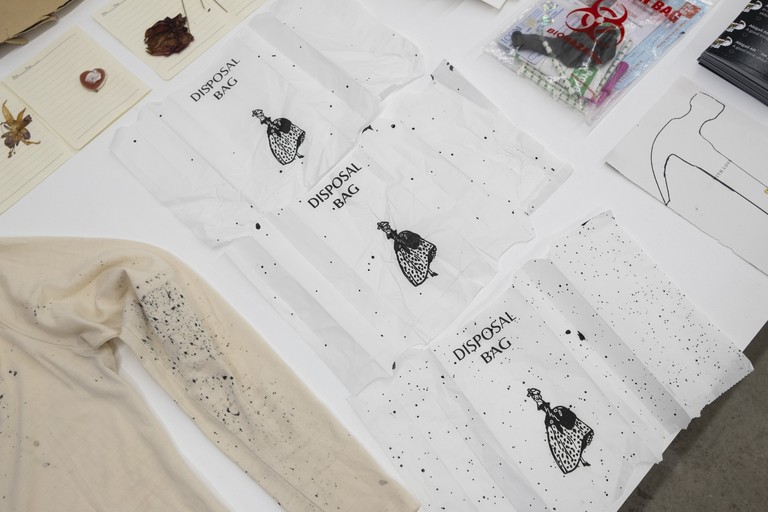
Abigail Aroha Jensen, Transit Holiday, 2026, detail view. Photo by Samson Dell.
In its attention to impermanence, Jensen’s practice is also rooted in the notion of gleaning, understood not only as a method of gathering, but as a social and ethical orientation toward what remains, what is overlooked and what persists at the margins. For the artist, everything is matter to be harvested, to weave with and fold into, including language itself. Slovenian neo-Marxist philosopher, cultural theorist and public intellectual (2026) comprises the transcription of a talk by Slavoj Žižek, following which he autographed Jensen’s ‘Hello Kitty’ phone case. Beyond its anecdotal cachet, the work considers how we identify with objects and how their mauri is both preserved and transferred to the body—a sideways glance at the whakapapa of things. Both displays activate forms of correlation that are dispersed and non-linear; the materials Jensen assembles carry with them the residues of prior relations, suggesting that address is always-already entangled.
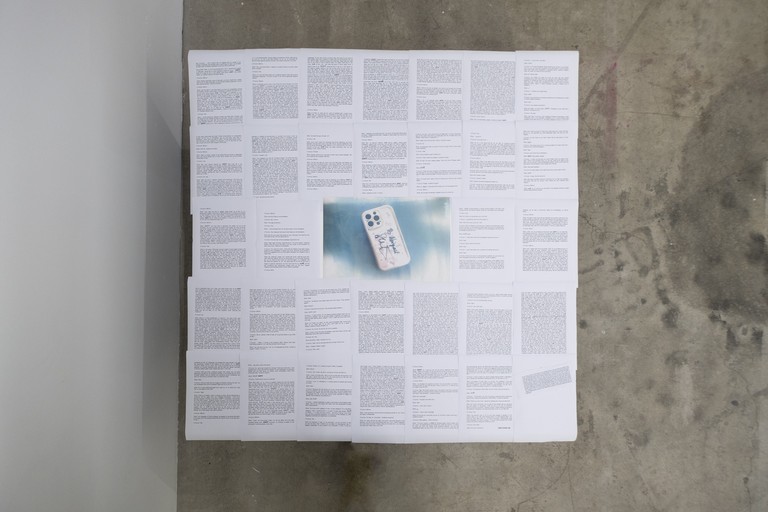
Abigail Aroha Jensen, Slovenian neo-Marxist philosopher, cultural theorist and public intellectual, 2026. Transcript from a voice memo recording, iPhone scan A3 art print, 250gsm, satin process. Photo by Samson Dell.
The title of the exhibition might be read as implying a fixed point of address, but this would be a fiction. Following Freud’s theory of free association, in which he compares the psychoanalytic situation to a train ride and the emergent free associations to the passing scenery, These are Addressed to You encourages a viewer’s own associative links and affinities between image, emotion and gesture. A letter is a form that unfolds; it travels, transforms and resists fixed definition. Across the exhibition, these artworks similarly elude fixity, instead embracing ambiguity and ambivalence as sites of critical and imaginative possibility. Meaning slips, as longing does, between senders.
-
1.
A precedent, or its inverse, might be Andy Warhol’s 1964 film Blow Job, in which the rapturous face of a young man fills the screen, his ecstasy projected at a speed two-thirds of its frame rate, creating a dramatic slow motion effect—yet the implied sexual act is never pictured. Like Warhol, Ader’s life and work is replete with its own kind of mythology, having disappeared mysteriously at sea in 1975. Ader was attempting to cross the Atlantic Ocean as an artistic gesture, the second part of an unrealised triptych of works titled In search of the miraculous.
-
2.
Jan Verwoert, “The Conceptuality of the Grand Emotions,” Camera Austria International, 71/2000, 3-14.
-
3.
Sharon Kivland, Abécédaire (London: Moist, 2022), 289.
-
4.
Gabriel Levine Brislin, “For Sharon Kivland, Writing is an Act of Connection,” frieze, 18 July 2025, https://www.frieze.com/article/sharon-kivland-these-are-addressed-to-you-book-review-2025.
-
5.
Sharon Kivland, These are Addressed To You (London: Bricks from the Kiln), 2025, xvi. A selection of twenty-six images from the series are reproduced within the pages of the publication.
-
6.
Ibid.
-
7.
Simone Weil, Waiting for God, trans. Emma Craufurd (London: Routledge, 1951).
-
8.
These include saint louis, saint louis (2024), août, 1838 (2025) and exsudat (2025).
-
9.
Saidiya Hartman, “Venus in Two Acts”, Small Axe, vol. 12, no. 2, 2008, 1–14, https://doi.org/10.1215/-12-2-1.
-
10.
Trinh T. Minh-ha, Woman, Native, Other: Writing Postcoloniality and Feminism (Bloomington: Indiana University Press, 2009), 90.
-
11.
The term is French psychoanalyst Georges-Henri Luquet’s, who is best known for pioneering the study of children's drawings and early visual cognition. See Richard P. Jolley, Children and Pictures: Drawing and Understanding (Chichester, UK: Wiley-Blackwell, 2009).
-
12.
As Robertson continues, the poetic (and here Dimick’s image-language) is constituted through iteration, transmission and play: “Language as poem, or poem as language, through recitation, formal play, historical transmission, sonic and scriptural innovation, shapely invention, moves intimately and concretely from mouth to mouth, from ear to ear, against the grain of the dominant measures and restrictions. Meaning is constituted and iterated through this movement, which produces its own ground.”
Cristina Politano, ‘[P]oetry is, at an occult or clandestine level, infinitely capacious: An Interview with Lisa Robertson,’ minor literatures[s], 14 May 2026, https://minorliteratures.com/2026/05/14/poetry-is-at-an-occult-or-clandestine-level-infinitely-capacious-an-interview-with-lisa-robertson-cristina-politano/.
-
13.
Christian Dimick, email correspondence with the author, 11 May 2026.
-
14.
Abigail Aroha Jensen, conversation with the author, 9 December 2025.